
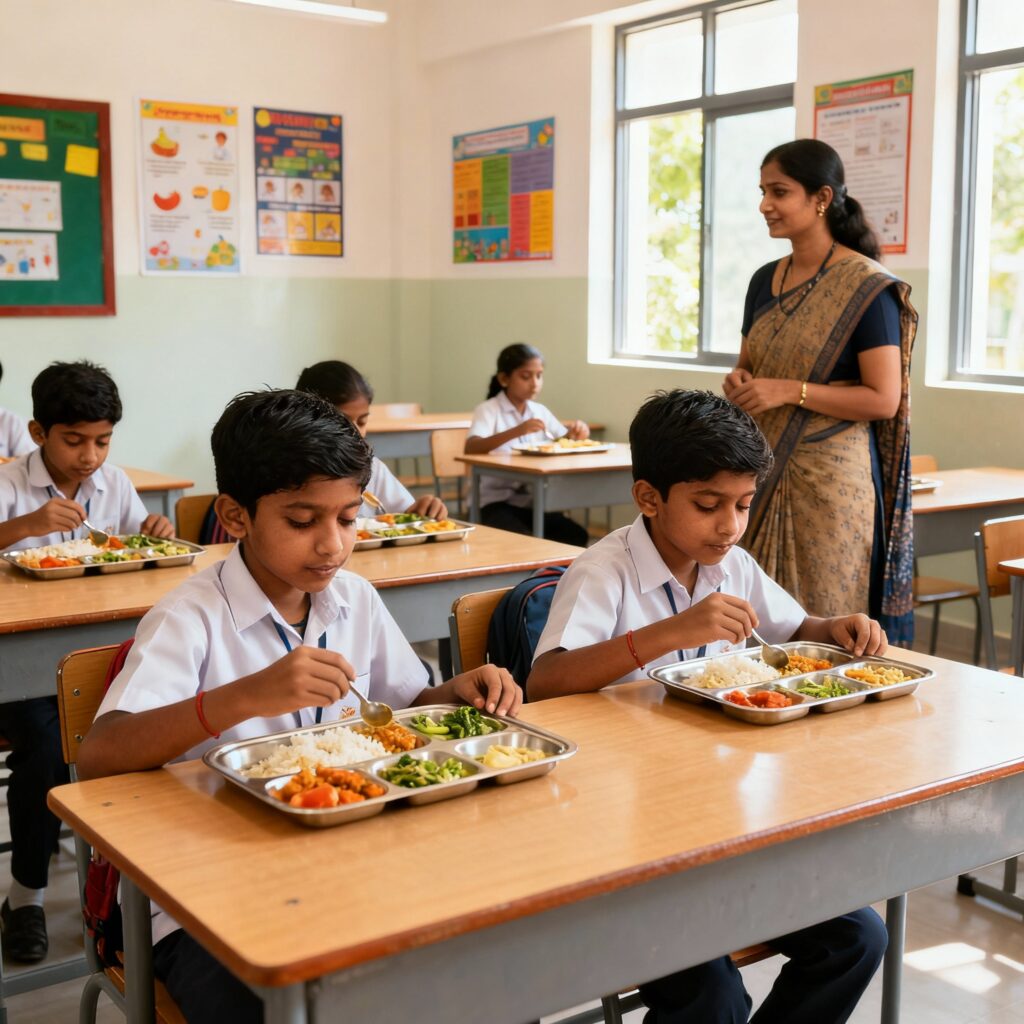
In the realm of public policy, few achievements can match the quiet revolution that has transformed India’s education landscape over the past three decades. What began as a modest school feeding program in 1995 has evolved into one of the most impactful policy interventions in the country’s history, contributing to a remarkable halving of India school dropout rates in just two years. This extraordinary transformation demonstrates how persistent, well-designed policy moves can create lasting change that touches millions of lives.
The story of India’s educational renaissance is not just about numbers; it’s about understanding how thoughtful governance, sustained commitment, and strategic implementation can overcome seemingly insurmountable challenges. From feeding 12 crore children daily to increasing forest cover by 2.5%, India’s policy successes offer valuable lessons for nations worldwide seeking to address complex social and environmental challenges.
The Genesis of Transformation: Midday Meal Scheme’s Humble Beginning
The foundation of India’s current educational success was laid in 1995 with the launch of the Midday Meal Scheme, initially designed as a modest intervention to improve enrollment, retention, and nutrition among students from disadvantaged groups. Starting with the simple provision of 100 grams of food grains per child per school day, this program would eventually become the world’s largest school feeding program, reaching approximately 12 crore children across 13 lakh government schools throughout India.
The evolution of this program reflects the power of incremental policy refinement. In 2001, a crucial shift occurred when children began receiving cooked midday meals instead of raw food grains, a change that dramatically improved both nutritional outcomes and school attendance. The program’s scope expanded again in 2008 to include students from classes 1st to 8th, demonstrating how successful policies naturally evolve to serve broader populations.
Dr Meera Samson, a researcher at the Centre for Development Economics, notes: “The Midday Meal Scheme represents a masterclass in policy evolution. What started as a targeted intervention became a comprehensive solution addressing multiple challenges simultaneously: hunger, education access, gender equity, and social cohesion.”
Unprecedented Achievement: Dropout Rates Plummet Across All Levels
The impact of sustained policy intervention has culminated in one of India’s most significant educational achievements. According to the Ministry of Statistics and Programme Implementation’s Comprehensive Modular Survey: Education 2025, conducted during April-June 2025 as part of the 80th round of the National Sample Survey, India school dropout rates have nearly halved across all educational levels within just two years.
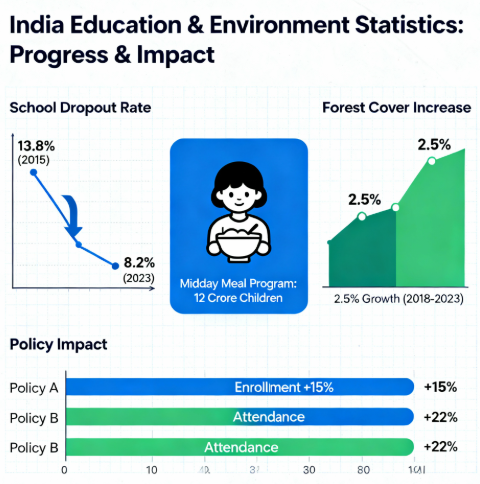
Secondary Level Transformation: The most dramatic improvement occurred at the secondary level, where dropout rates plummeted from 13.8% in 2022-23 to just 8.2% in 2024-25, representing a 40% reduction in just two years. This achievement is particularly significant given that secondary education has traditionally faced the highest dropout rates due to various socio-economic pressures.
Middle Level Success: At the middle school level, dropout rates fell from 8.1% to 3.5%, while at the preparatory level, the rate declined from 8.7% to 2.3%. These improvements signal a structural turnaround in retention, with more children staying enrolled and completing their schooling across all educational stages.
Education policy researcher Dr Yamini Aiyar from the Centre for Policy Research explains: “This isn’t just a statistical improvement; it represents a fundamental shift in how Indian families view education. The combination of nutritional support, financial incentives, and improved infrastructure has created an ecosystem where education becomes both accessible and valuable.”
The Three-Pillar Strategy Behind Success
The remarkable reduction in India school dropout rates cannot be attributed to a single intervention but rather to three comprehensive policy pillars that address various barriers to education.
Pillar 1: Nutritional Foundation Through Midday Meal Impact
The Midday Meal Scheme has proven to be far more than a school feeding program; it’s become a cornerstone of educational access and equity. Research consistently shows that regular access to midday meals improves enrollment, attendance, and retention rates among children, resulting in lower dropout rates and higher academic achievement.
Academic Outcomes: A systematic review of studies assessing academic outcomes before and after MDMS implementation revealed substantial improvements in school enrollments, student attendance rates, and considerable reductions in dropout rates. The scheme particularly benefits girls and children from marginalised communities, who face the greatest barriers to education.
Social Integration: Beyond nutritional benefits, the program promotes social equity by bringing children from diverse communities together to share meals, helping dismantle caste barriers and fostering inclusive environments. This social dimension has proven crucial in encouraging families from traditionally disadvantaged groups to prioritise education.
The school feeding program now reaches 12 crore children daily, making it not just the world’s largest such program but also one of the most effective in terms of educational outcomes.
Pillar 2: Financial Support Through Targeted Scholarships
The government has implemented a comprehensive scholarship ecosystem targeting disadvantaged groups, with programs ranging from school-level support to higher education funding.
Merit-cum-Means Scholarships: Programs like the Reliance Foundation Undergraduate Scholarships support approximately 5,000 meritorious students annually with up to ₹2 lakhs over the duration of their degree. Similarly, the SBI Platinum Jubilee Asha Scholarship provides awards ranging from ₹15,000 to ₹20 lakhs, with 50% slots reserved for female candidates and 50% for SC/ST students.
Gender-Focused Initiatives: The Azim Premji Scholarship specifically targets girl students from disadvantaged backgrounds, providing ₹30,000 annually for the entire duration of undergraduate programs. Such targeted interventions address the specific challenges faced by girls in accessing higher education.
Impact on Retention: These financial interventions directly address one of the primary causes of school dropout, economic pressure on families. By reducing the opportunity cost of education, scholarships enable families to prioritise children’s schooling over immediate economic contributions.
Pillar 3: Infrastructure Revolution Through Samagra Shiksha Abhiyan
The Samagra Shiksha Abhiyan, launched in 2018 and allocated ₹41,250 crores in 2025, represents a comprehensive approach to educational infrastructure development. This integrated scheme combines three major education programs: Sarva Shiksha Abhiyan (SSA), Rashtriya Madhyamik Shiksha Abhiyan (RMSA), and Teacher Education (TE), creating a unified education system.
Infrastructure Development: The scheme supports the construction of additional classrooms, separate toilets for boys, girls, and children with special needs (CWSN), provision of drinking water, electricity, boundary walls, libraries, ICT facilities, and digital classrooms. These improvements directly address practical barriers that contribute to student dropout.
Digital Integration: The program emphasises establishing 5,000+ smart classrooms with AI-based learning tools, providing free tablets and digital resources to students in government schools, and expanding the DIKSHA platform to offer learning materials in multiple regional languages.
Quality Improvements: The reduction in single-teacher schools (from 1,18,190 in 2022-23 to 1,04,125 in 2024-25) and zero-enrollment schools (down by 38% in a year) demonstrates the scheme’s effectiveness in creating viable learning environments.
Policy Framework: National Education Policy 2020’s Role
The National Education Policy (NEP) 2020 has provided the overarching framework for educational transformation, introducing the 5+3+3+4 structure that replaces the traditional 10+2 system and aligns educational stages with children’s developmental needs.
Flexibility and Inclusion: NEP 2020 emphasises early childhood education, multilingual learning, and vocational training from Class 6 onwards. This flexibility has been credited as one of the factors contributing to improved retention rates by making education more relevant and accessible to diverse learning needs.
Foundational Focus: The policy’s emphasis on achieving universal foundational literacy and numeracy by 2025 addresses one of the root causes of later educational dropout—weak foundational skills that make progression through higher grades challenging.
No Detention Policy Revision: In December 2024, the government scrapped the ‘No Detention Policy’ for Classes 5 and 8, requiring students to pass examinations to progress. This change, while initially controversial, has been credited with improving learning outcomes and ensuring students develop the necessary foundational skills before advancing.
Beyond Education: Forest Conservation Success Story
India’s policy success extends beyond education to environmental conservation, demonstrating the government’s ability to achieve long-term goals through consistent policy implementation. India’s forest cover increased by 2.5% between 2010-11 and 2021-22, adding 17,444 sq km of forest land over the decade.
Quality Improvement: While the overall increase appears modest, the ‘very dense forest’ (VDF) segment recorded a remarkable 22.7% growth, increasing from 83,502 sq km to 1,02,502 sq km. This indicates successful conservation and natural regeneration efforts, with forest quality improving in critical ecological areas.
Conservation Programs: The growth results from several conservation programs across the country that started quietly but expanded systematically over the years, promoting tree protection and plantation initiatives. These programs demonstrate that the same principles of patient, persistent policy implementation that succeeded in education can be applied to environmental challenges.
The Science of Effective Policymaking
The success of both educational and environmental policies in India illustrates several key principles of effective policymaking that can be applied to address complex societal challenges.
Incremental Evolution vs. Revolutionary Change
Dr Lant Pritchett, a development economist at Harvard Kennedy School, observes: “India’s educational success demonstrates that sustainable policy change often occurs through incremental improvements rather than dramatic overhauls. The Midday Meal Scheme’s evolution from food grain distribution to cooked meals to comprehensive nutritional support shows how policies can adapt and improve over time.”
Evidence-Based Refinement
India’s policy successes are characterised by continuous monitoring and evidence-based refinement. The annual surveys measuring dropout rates, nutrition outcomes, and academic performance provide data for ongoing program improvement.
Measurable Key Performance Indicators (KPIs) have been developed for every component of major schemes, ensuring accountability and enabling course corrections when necessary.
Current Challenges and Future Prospects
Despite remarkable progress, significant challenges remain in India’s educational landscape, requiring continued policy attention and refinement.
Affordability Concerns
While dropout rates have decreased, the cost of education continues to rise for families. In rural India, average annual expenditure per student in government schools was ₹2,639 compared to ₹19,554 in private institutions. This suggests that families are stretching their finances to sustain education, even as retention improves.
Geographic and Social Disparities
State-wise analysis reveals significant variations in dropout rates, with northeastern states and tribal areas still facing higher challenges. Manipur shows a 12.6% dropout rate at the primary level, while Kerala achieves just 0.1%.
Global Lessons and Economic Impact
India’s experience offers valuable insights for other developing nations seeking to improve educational outcomes and implement large-scale social programs.
Human Capital Development
Dr Eric Hanushek from Stanford University’s Hoover Institution estimates that improving educational outcomes can increase GDP growth by 0.5-1.5 percentage points annually. India’s success in retention and quality improvement positions the country for significant economic dividends over the coming decades.
Demographic Dividend Realisation
With 50% of India’s population under 25, the educational improvements directly contribute to realising the country’s demographic dividend. Better-educated youth can participate more effectively in the global economy and drive innovation and growth.
Conclusion: The Power of Persistent Policy
India’s remarkable success in halving school dropout rates while simultaneously improving forest conservation demonstrates the transformative power of well-designed, persistently implemented public policies. The journey from a modest school feeding program in 1995 to the world’s largest midday meal scheme reaching 12 crore children illustrates how small policy moves can indeed bring about massive changes.
The story offers several crucial lessons for policymakers worldwide: persistence pays, integration amplifies impact, evidence-based evolution enables continuous improvement, and community engagement ensures sustainability.
As Dr Amartya Sen observed, “Development is ultimately about expanding human capabilities and freedoms.” India’s educational transformation represents exactly this, the systematic expansion of opportunities for millions of children who might otherwise have been excluded from the possibility of a better future.
The challenge now lies in maintaining this momentum while addressing remaining inequities and ensuring that improved access translates to genuine learning and life opportunities. The foundation has been laid through patient, persistent policy work. Building upon it will require the same combination of vision, commitment, and adaptive implementation that created this remarkable transformation.
India’s experience proves that in the realm of public policy, there may be no magic bullets, but there are certainly magic processes, those patient, evidence-based, community-engaged efforts that can indeed change the trajectory of millions of lives. The halving of school dropout rates is not just a statistical achievement; it represents the dreams and potential of a generation that will now have the opportunity to shape India’s future in ways that would have been impossible just a few years ago.