
Myanmar, Sri Lanka, Pakistan, Bangladesh and now Nepal too? India is surrounded by unrest from north to south.
A Deep Dive into India’s South Asia leadership.
South Asia is in flux. After economic meltdowns in Sri Lanka and Bangladesh, Nepal is now showing signs of distress. The spotlight turns to Kathmandu, where inflation, debt, and political instability are merging into a perfect storm.
This blog unpacks the crisis in Nepal, compares it with its neighbours, and explores what it means for India and the broader region & India’s south asia leadership and firm command amid all the chaos.
Nepal’s Economic Freefall: What’s Going Wrong?
Nepal’s economy is shrinking. Inflation is rising. Foreign reserves are depleting. And the government is struggling to maintain basic services.
- Inflation has crossed 8%, hitting food and fuel prices hardest
- Foreign reserves have dropped below $10 billion, threatening import capacity
- Remittances, which make up nearly 25% of GDP, are slowing due to global downturns
The country’s reliance on tourism and remittances has made it vulnerable to global shocks. And unlike India, Nepal lacks the industrial base to cushion the blow.
Debt Trap Diplomacy: China’s Shadow Over Nepal
Nepal’s growing ties with China are raising eyebrows. Under the Belt and Road Initiative (BRI), China has funded infrastructure projects across Nepal, but at a cost.
- High-interest loans have added to Nepal’s debt burden
- Chinese contractors and materials dominate local projects, sidelining Nepali firms
- Strategic assets, like airports and highways, are increasingly under Chinese influence
This mirrors the pattern seen in Sri Lanka, where Chinese-funded projects led to unsustainable debt and eventually an economic collapse.
Political Instability: A Government in Crisis
Nepal’s political landscape is fragmented. The coalition government led by Prime Minister Pushpa Kamal Dahal (Prachanda) is struggling to maintain unity.
- Frequent cabinet reshuffles
- Disagreements over foreign policy
- Public protests over inflation and corruption
This instability is eroding investor confidence and delaying critical reforms. Without political clarity, economic recovery remains a distant dream.
Lessons from Bangladesh and Sri Lanka
Nepal’s crisis isn’t isolated. It follows similar patterns seen in:
- Sri Lanka, where debt, corruption, and fuel shortages led to mass protests and regime change
- Bangladesh, which narrowly avoided collapse through an IMF bailout and strict austerity measures
These examples show that early intervention, transparency, and diversified economies are key to survival. Nepal, however, seems to be repeating the same mistakes.
What This Means for India
India shares deep cultural, economic, and strategic ties with Nepal. A crisis in Kathmandu affects New Delhi directly.
- Trade routes and border security could be disrupted
- Migration pressures may increase
- China’s growing influence threatens India’s strategic depth
India has offered aid and technical support, but it must tread carefully. Heavy-handed intervention could backfire politically. Smart diplomacy and regional cooperation are the way forward.
The Bigger Picture: South Asia’s Fragile Future
South Asia is home to over 2 billion people, but its economies are fragile. Common challenges include:
- Over-reliance on imports
- Political instability
- Climate vulnerability
- Youth unemployment
The region needs a new economic model, one that prioritises sustainability, regional trade, and digital innovation.
India, as the largest economy in the region, has a leadership role to play. But it must balance ambition with empathy.
Myanmar: Civil War and Collapse
Since the 2021 coup, Myanmar has spiralled into a full-blown civil war. Ethnic militias and pro-democracy forces now control large swaths of territory, while the junta clings to urban centres with brutal airstrikes and forced conscription.
- Over 3.5 million displaced, 20 million need aid
- India’s Kaladan transport project hangs in the balance
- Refugees have poured into Mizoram, straining local resources
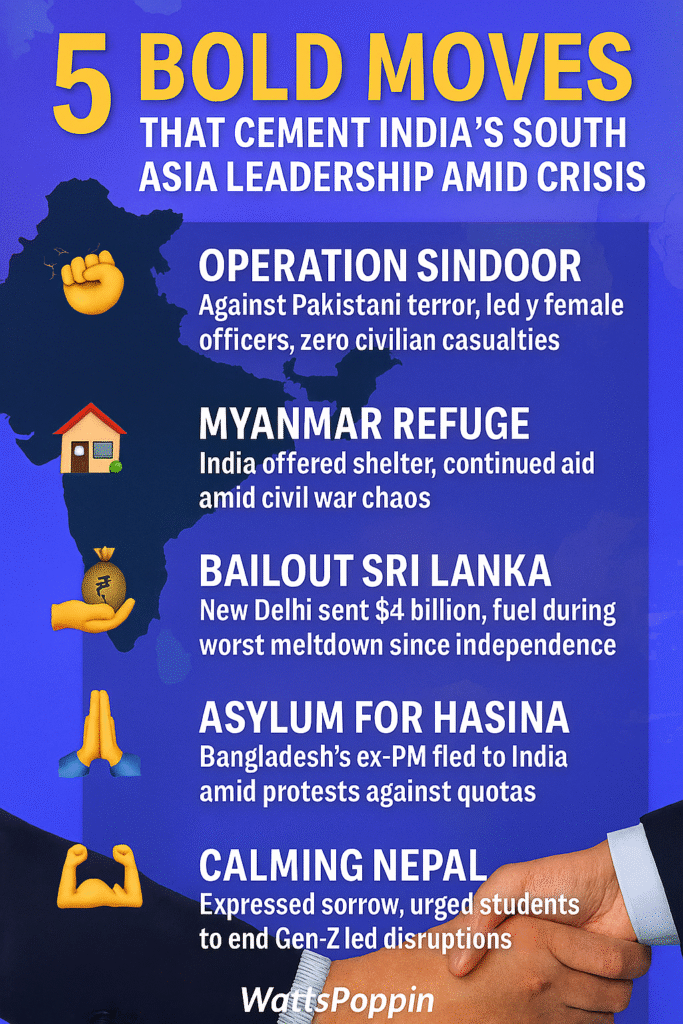
India has responded with caution, offering humanitarian support, sheltering refugees, and continuing infrastructure diplomacy while avoiding overt interference.
Sri Lanka: From Collapse to Recovery
In 2022, Sri Lanka plunged into its worst economic crisis since independence. Fuel, food, and medicine vanished. The Rajapaksa regime collapsed under mass protests. It is 2025, and the country is recovering, but slowly.
- IMF bailouts and reforms have stabilised inflation
- Poverty remains high, and trust in governance is fragile
- India stepped in with $4 billion in aid, fuel shipments, and diplomatic support
India’s role was decisive, offering lifelines when others hesitated, and proving that regional leadership means showing up when it matters.
Bangladesh: Quotas, Chaos, and Collapse
In 2024, student protests over job quotas exploded into a nationwide movement. Prime Minister Sheikh Hasina resigned and fled to India. An interim government led by Muhammad Yunus took over, but unrest continues.
- Inflation above 12%, youth unemployment at 28%
- Garment sector layoffs, declining remittances
- Rising extremism and erosion of civil liberties
India offered asylum, engaged diplomatically, and maintained trade flows, balancing support with sovereignty.
Pakistan: Perpetual Instability
Pakistan’s crisis is chronic. Political vendettas, military dominance, and extremist violence have hollowed out governance.
- Suicide bombings, insurgency in Balochistan
- Breakdown of talks between PTI and the ruling coalition
- Economic stagnation and rising intolerance
India’s approach has been firm but restrained in defending its borders, responding to terror provocations (like in Operation Sindoor & many more), and maintaining diplomatic distance.
India’s Response: Strategic Empathy
India’s Neighbourhood First policy isn’t just a slogan; it’s a balancing act of aid, diplomacy, and restraint.
- In Sri Lanka, India was the first responder
- In Bangladesh, India offered refuge and dialogue
- In Nepal, India expressed sorrow and urged calm during Gen Z-led protests
- In Myanmar, India continues to support infrastructure and humanitarian efforts without taking sides
India’s strength lies in its ability to be firm when needed and generous when asked.
Global Influence, Regional Responsibility
India’s rise on the world stage, through tech diplomacy, oil autonomy, and Global South leadership, is deeply tied to its ability to manage its own backyard.
- Stability in South Asia is a strategic asset
- India’s credibility as a global power depends on its regional stewardship
- The West may see India as rebellious, but the region sees it as dependable
India is not the West’s problem; it’s the region’s possibility.
Final Thoughts: Crisis as a Catalyst
India isn’t just rising, it’s anchoring. In a neighbourhood of collapsing regimes, civil wars, and economic chaos, India is the one country that’s growing, stabilising, and showing up.
From Operation Sindoor to Sri Lanka’s bailout, from Myanmar’s refugee crisis to Bangladesh’s political transition, India’s south asia leadership has proven that leadership isn’t loud. It’s consistent.
And in a world that’s watching, India is quietly redrawing the map, not just of power, but of principle.
Nepal’s crisis is alarming, but it’s also a wake-up call. For policymakers. For citizens. For the region.
It’s a reminder that economic health isn’t just about numbers; it’s about governance, resilience, and vision.
At this point, South Asia doesn’t need saviours, it needs systems.
If you want to write email us at pluggedin@wattspopp.in