
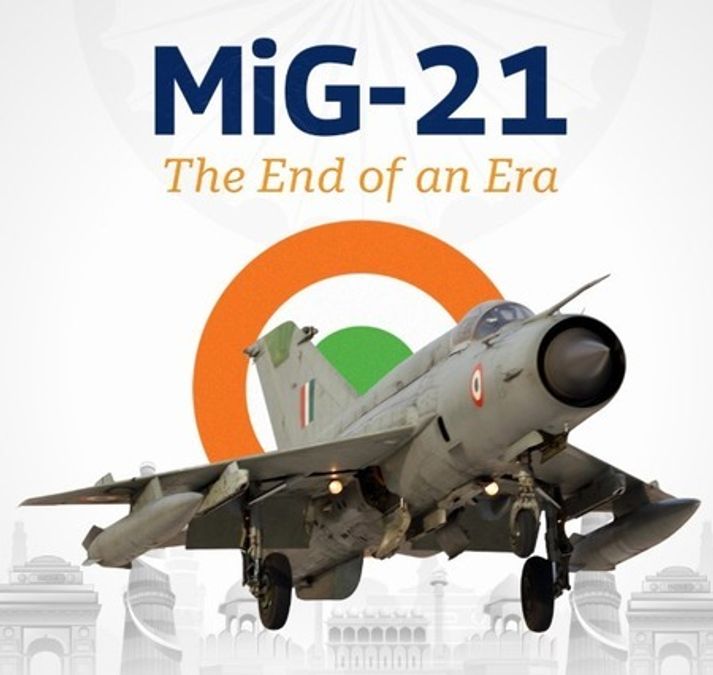
On September 26, 2025, a defining chapter in India’s military aviation history closed with thunderous finality at the Chandigarh Air Force Station. The iconic MiG-21, India’s first supersonic fighter jet, took its final flight after an extraordinary six decades of service, marking the end of an era that witnessed the evolution of the Indian Air Force from a regional force to a formidable military power.
The farewell ceremony was nothing short of spectacular. Six MiG-21 Bison variants, led by Air Chief Marshal AP Singh himself with the call sign ‘Badal 3’, soared through the cloudless sky one last time. Squadron Leader Priya Sharma, India’s seventh woman fighter pilot, flew alongside the Air Chief in this historic final sortie. Defence Minister Rajnath Singh, military leaders, veterans, and families gathered to witness this poignant moment as the jets received a water cannon salute upon landing[8][14].
From Soviet Import to Indian Workhorse
The MiG-21’s journey in India began in 1963 when the first batch arrived from the Soviet Union, representing a significant leap in India’s aerial capabilities[2][5]. This needle-nosed fighter was India’s introduction to supersonic flight, and by the 1980s, it had become the absolute backbone of the Indian Air Force. At its peak, the IAF operated 19 squadrons of MiG-21s, comprising over 870 aircraft that constituted nearly two-thirds of India’s entire fighter fleet.
The aircraft’s design, created by the Soviet Mikoyan-Gurevich bureau, was revolutionary for its time. Its delta-wing configuration and powerful engine made it capable of speeds exceeding Mach 2, transforming India’s air defence capabilities overnight. The first squadron, the 28 Squadron, raised in Chandigarh, was aptly nicknamed ‘First Supersonics’, acknowledging its groundbreaking role in Indian aviation.
Combat Legacy: From 1971 to Balakot
The 1971 War Glory
The MiG-21’s combat debut came during the 1971 Indo-Pakistani War, where it played a pivotal role in establishing Indian air superiority. During this conflict, MiG-21s launched devastating air raids over East Pakistan, with one particularly significant strike hitting the governor’s house in Dhaka. This demonstration of aerial power contributed to Pakistan’s decision to surrender, showcasing the strategic impact of India’s new supersonic capability.
The 1971 war witnessed the first supersonic air combat in the subcontinent, with Indian MiG-21FLs claiming multiple Pakistani aircraft, including F-104 Starfighters, F-6Cs, and F-86 Sabres. The aircraft’s success was so notable that several nations, including Iraq, approached India for MiG-21 pilot training, establishing India as a regional aviation power.
The Legendary 2019 Balakot Engagement
Perhaps the MiG-21’s most celebrated moment came in 2019 during the aftermath of the Balakot strikes. On February 27, 2019, Wing Commander Abhinandan Varthaman, flying a MiG-21 Bison (the upgraded variant), engaged Pakistani F-16s in aerial combat over Pakistan-occupied Kashmir. In a David versus Goliath encounter, the ageing Soviet-era fighter successfully shot down a modern American-made F-16, proving that in skilled hands, the MiG-21 remained lethal even against contemporary adversaries.
This engagement became legendary not just for the technical achievement but for what it represented, the culmination of six decades of pilot training, aircraft evolution, and tactical expertise. The MiG-21 Bison’s victory over the F-16 demonstrated that technological sophistication alone doesn’t guarantee air superiority; pilot skill, tactical awareness, and operational experience remain crucial factors in aerial combat.
The Dark Side: Safety Concerns and “Flying Coffin” Label
Despite its combat prowess, the MiG-21’s service record was marred by a troubling safety profile that earned it the grim nickname “flying coffin.” Between 1971 and 2012, the aircraft experienced 482 crashes, claiming the lives of 171 pilots, 39 civilians, eight service personnel, and one aircrew member. This represents an attrition rate of over 55% of the 872 aircraft originally inducted into service.
However, former IAF Chief Air Chief Marshal B.S. Dhanoa (retd) presented data showing that the MiG-21’s accident rate of 2.95 per 10,000 flying hours was actually comparable to or better than other fighters in the IAF fleet. The GNAT had an accident rate of 6.88, the Hunter 4.26, and the MiG-23 and MiG-27 had similar rates of 2.95 and 3.04, respectively. This data suggests that the “flying coffin” label may have been somewhat unfair, considering the aircraft’s extensive service and high operational tempo.
The crashes were attributed to various factors, including ageing airframes, maintenance challenges, pilot error, and the aircraft’s demanding flight characteristics. The MiG-21’s high-speed approach requirements and short runway operations made it particularly challenging to fly, requiring exceptional pilot skill and precision.
India’s Current Fighter Squadron Crisis
The retirement of the MiG-21 has left the Indian Air Force in a precarious position regarding squadron strength. With the final two squadrons, No. 23 (Panthers) and No. 3 (Cobras), now retired, the IAF’s fighter strength has dropped to just 29 squadrons, well below the sanctioned strength of 42 squadrons. This represents the lowest squadron strength since the 1960s, a concerning development given India’s complex security environment with potential two-front threats from Pakistan and China.
Each fighter squadron typically consists of 16-18 aircraft, meaning India now operates approximately 522 fighter jets compared to China’s estimated 1,200 and Pakistan’s 450. This numerical disadvantage becomes even more pronounced when considering the technological gap, as China operates multiple squadrons of fifth-generation aircraft while developing sixth-generation capabilities.
The Tejas Challenge: Delays and Production Issues
India’s strategy to replace the MiG-21 with the indigenous Tejas Light Combat Aircraft (LCA) has faced significant challenges. The LCA program, conceived in 1983 specifically to replace the ageing MiG-21 fleet, has suffered from decades of delays and production bottlenecks.
Currently, only two Tejas Mk1 squadrons are operational: No. 45 Squadron (Flying Daggers) at Sulur Air Force Station and one other squadron. Despite signing a contract for 83 Tejas Mk1A aircraft in 2021, worth approximately $6.5 billion, not a single aircraft has been delivered as of September 2025. The expected delivery timeline has been pushed from March 2024 to 2026, with Hindustan Aeronautics Limited (HAL) citing engine supply issues from GE Aerospace as a primary cause.
The production challenges are compounded by the fact that even when deliveries begin, HAL can only produce 10-12 aircraft annually. At this rate, completing the order for 180 Tejas aircraft (83 Mk1A plus 97 additional aircraft approved in 2025) would take approximately 15 years, leaving a significant capability gap during this transition period.
Future Implications and Strategic Concerns
The timing of the MiG-21’s retirement coincides with a critical period in South Asian security dynamics. China’s People’s Liberation Army Air Force (PLAAF) has rapidly modernised with 66 squadrons, while Pakistan operates 25 squadrons. India’s reduced squadron strength raises concerns about its ability to effectively defend against potential multi-front scenarios.
Air Chief Marshal AP Singh has stated that the IAF needs to induct 35-40 fighter aircraft annually to address the capacity shortfall. The service is exploring multiple options, including additional Rafale acquisitions under the Multi-Role Fighter Aircraft (MRFA) program, potential Su-57 procurement from Russia, and accelerated indigenous production.
The government has recently approved a $7.2 billion deal for 97 additional Tejas Mk1A fighters, bringing the total order to 180 aircraft. However, given the production delays and technological challenges, questions remain about whether this indigenous solution can adequately fill the capability gap left by the MiG-21’s retirement.
Lessons from Six Decades of Service
The MiG-21’s retirement offers several important lessons for India’s defence establishment. First, the dangers of over-reliance on a single platform become apparent when that system eventually reaches end-of-life. The MiG-21’s extended service, well beyond its intended operational life, was necessitated by the lack of adequate replacement systems.
Second, the importance of indigenous capability development cannot be overstated. While the MiG-21 served admirably, its foreign origin meant dependence on external suppliers for critical components and upgrades. The Tejas program, despite its delays, represents a crucial step toward self-reliance in defence technology.
Third, the need for realistic timeline planning in defence procurement is evident. The 40-year gap between the MiG-21’s planned replacement (1983) and the current state of the Tejas program highlights the importance of early and sustained investment in next-generation capabilities.
The Legacy Lives On
Despite its controversial safety record, the MiG-21 leaves behind an undeniable legacy. Virtually every fighter pilot in the Indian Air Force has flown either the original MiG-21 or one of its variants, making it the training foundation for generations of aviators. The aircraft participated in every major conflict involving India since 1965, from the wars with Pakistan to the Kargil conflict and the recent tensions following Pulwama.
Group Captain Indranil Nandi captured this sentiment perfectly: “The MiG-21 has the distinction of being an aircraft that has trained generations of Indian fighter pilots. It was a joy to fly. It made me the fighter pilot I am today.”
As the final MiG-21s taxi into retirement, they take with them six decades of memories, courage, sacrifice, and excellence. The water cannon salute at Chandigarh was not just a farewell to an aircraft, but a tribute to an era that shaped India’s air power and the thousands of pilots who trusted their lives to this remarkable machine.
The challenge now lies in ensuring that the lessons learned from the MiG-21 era inform India’s future aviation strategy, emphasising the need for timely procurement, indigenous capability development, and maintaining adequate squadron strength to face the security challenges of the 21st century.