
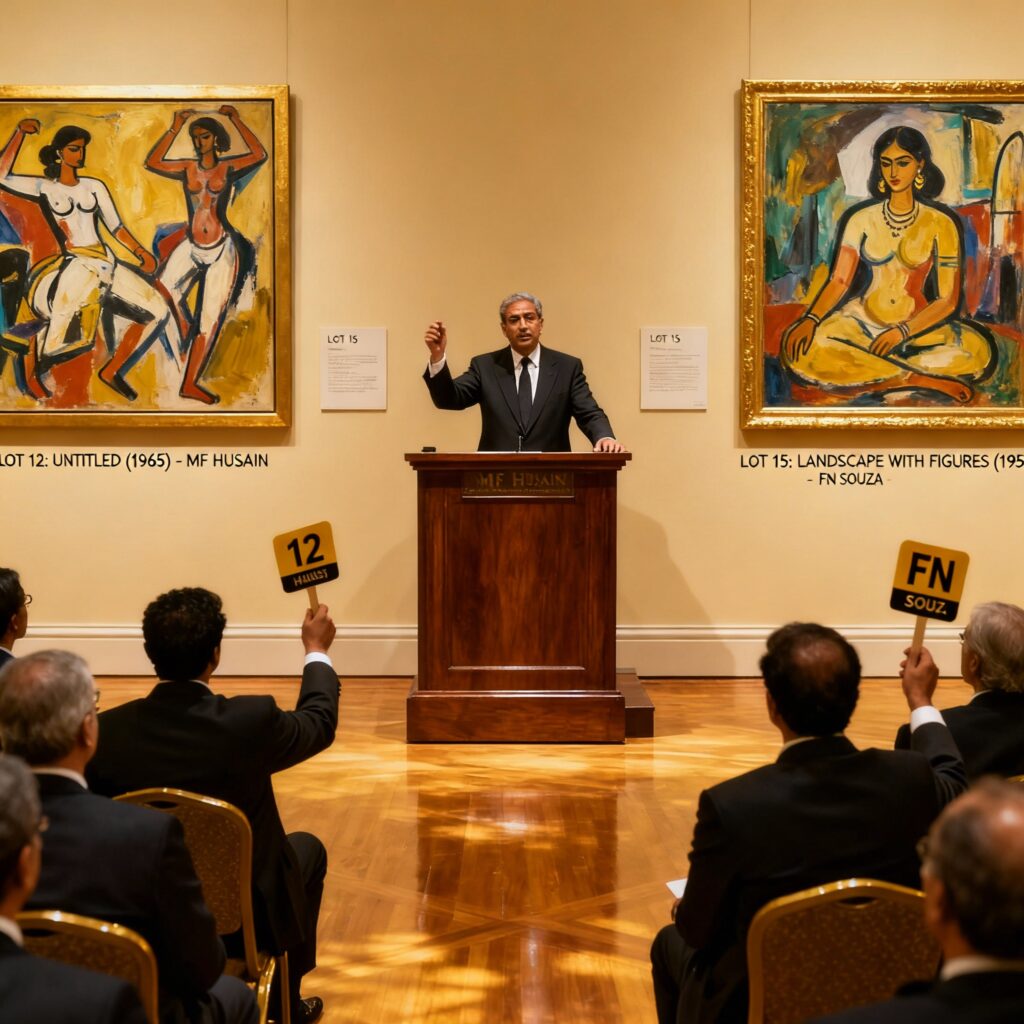
While the global art market grapples with a significant downturn, India’s art scene is experiencing an unprecedented renaissance that has captured international attention. As auction houses worldwide report declining sales and struggling valuations, the India’s art market boom is shattering records and attracting both domestic and international collectors with remarkable consistency.
The Numbers Tell a Compelling Story
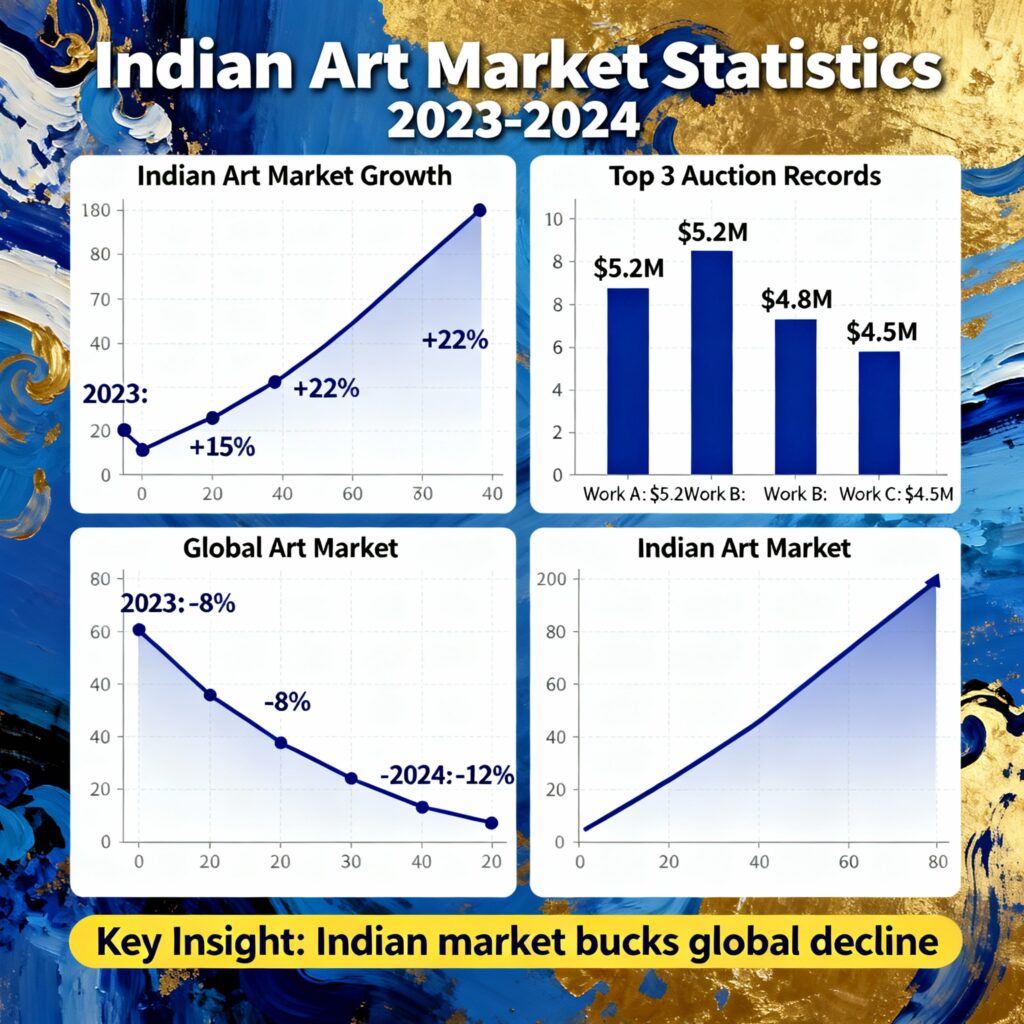
The contrast between India’s art market boom performance and global trends couldn’t be more striking. Global art sales plummeted by 12% in 2024 to an estimated $57.5 billion, marking the second consecutive year of decline. Major art markets from China to the United States, France to Italy, all witnessed significant contractions, with China experiencing the most severe drop of 33%.
Against this backdrop, India’s art market boom story has emerged as a beacon of growth and stability. The Indian art market witnessed its most monumental month in September 2025, recording an unprecedented total turnover of ₹865.8 crores ($97.8 million) – a historic figure that surpasses the individual annual turnovers recorded by the Indian art market in any year before 2021.
Industry experts estimate the Indian art investment market to reach ₹10,000 crores by 2030 if current momentum continues, representing a dramatic transformation from the ₹15 crores market value in 2000 to today’s ₹3,000+ crore valuation.
Record-Breaking Sales Define 2025
The year 2025 has been particularly remarkable for India’s art auction records, with multiple records being shattered within months:
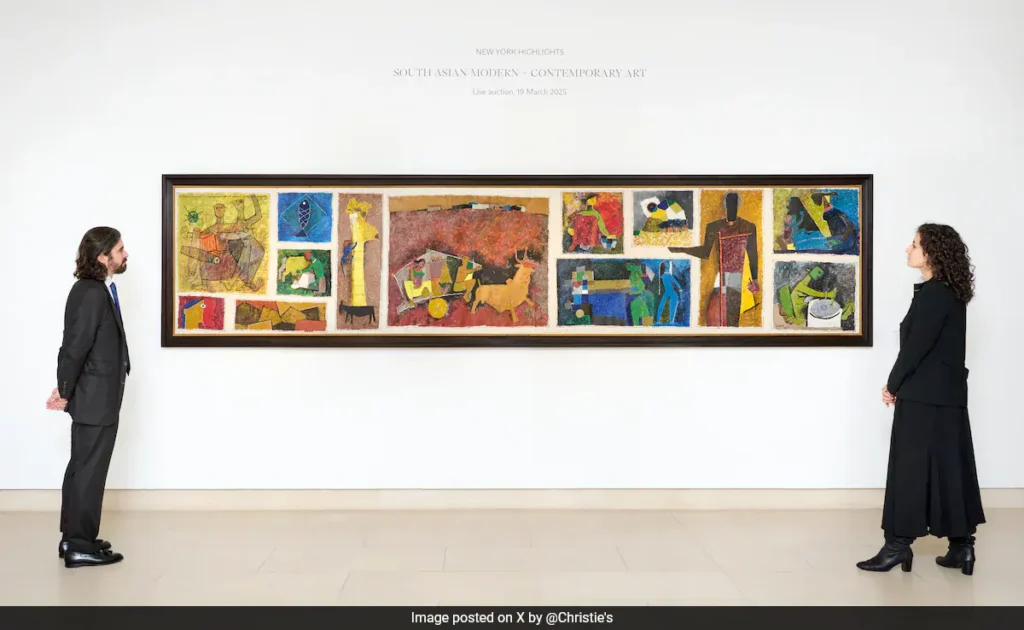
M.F. Husain’s Historic Achievement: In March 2025, legendary painter M.F. Husain’s painting sale of “Untitled (Gram Yatra)” from 1954 sold for a staggering $13.8 million (₹118+ crores) at Christie’s Indian art auction in New York, becoming the most expensive modern Indian artwork ever sold at auction. The 14-foot-wide canvas, comprising 13 unique panels, nearly quadrupled its high estimate of $3.5 million and attracted five determined bidders.
Vasudeo Gaitonde’s September Triumph: In September 2025, abstract master Vasudeo Gaitonde’s artwork achieved ₹67.08 crores at the Saffronart auction, becoming the second most expensive Indian artwork sold at auction. The yellow ochre painting with translucent layers garnered nearly three times its higher estimate.
Saffronart’s Milestone Achievement: The same September auction by Saffronart achieved a cumulative sales value of ₹355.77 crores ($40.2 million), marking the highest-ever sale of South Asian art at a global auction with all 85 lots sold – a complete “white glove” sale.
These achievements represent more than individual records; they signal a fundamental shift in how Indian art is perceived and valued globally.
The Economic Engine Behind the Boom
India’s robust economic performance serves as the primary catalyst for this Indian art market boom. Barring the pandemic years, India’s GDP has grown annually at an average rate of over 7% since 2009, creating a new generation of high-net-worth individuals with disposable income and cultural aspirations.
This economic growth has translated into increased appetite for art among India’s wealthy elite. As Dinesh Vazirani, Saffronart CEO, observes: “Today, Indians have generated wealth, are buying nice homes, and are increasingly also feeling the social pressure to acquire good art, as people now understand what is good art”.
The new rich are diversifying their portfolios by including expensive artworks, viewing art as a relatively stable investment that isn’t as subject to market volatility. During COVID-19, while most markets contracted, the art market actually expanded, demonstrating its resilience as an asset class.
Market Dynamics and Collector Behaviour
The Indian art investment market is becoming increasingly sophisticated and selective. Analysis shows that while the total number of artworks offered in auctions has declined from 4,469 to 3,939 in recent fiscal years, the average price per artwork has risen to ₹42.3 lakh, marking a 7.1% increase.
Premium Segment Growth: The most significant growth has occurred in the mid-to-high price segments. Artworks priced between ₹1 crore and ₹10 crore saw the number of sold lots climb to 279 from 234, showing a 19% increase. This preference for expensive artworks reflects the maturity and confidence of Indian collectors.
Modern vs Contemporary Art: Modern Indian artists continue to dominate the market, though contemporary art showed strong growth with a 31.8% increase. The post-independence segment experienced some challenges with a 12.1% downturn, while emerging artists witnessed a massive 99.3% jump, highlighting new collector appetite for undiscovered talent.
Tribal and Folk Art Revival: The market also witnessed a fourfold increase in tribal art sales, indicating growing appreciation for India’s diverse artistic traditions beyond mainstream modern masters.
The Rise of India’s “Modern Masters”
The auction success is particularly pronounced for India’s “modern masters”, the group of celebrated painters including M.F. Husain, F.N. Souza, S.H. Raza, and Vasudeo Gaitonde. These artists, who pioneered modern Indian art in the post-independence era, are now achieving international recognition and pricing that reflects their historical significance.
M.F. Husain’s Legacy: Known as the “Picasso of India,” Husain’s work has consistently broken records. His “Gram Yatra” sale represents not just a price milestone but recognition of his contribution to Indian modernism and the celebration of India’s cultural diversity.
Vasudeo Gaitonde’s Abstract Vision: The reclusive abstract expressionist Gaitonde, who died in relative obscurity in 2001, has become a darling of auctions in the past decade. His limited output, which wasn’t prolific, has created scarcity that drives prices upward as collectors compete for rare works.
Amrita Sher-Gil’s Enduring Appeal: The Hungarian-Indian painter’s “The Story Teller” (1937) held the record at $7.4 million before being surpassed, demonstrating the sustained appeal of early modernist works.
Digital Transformation and Accessibility
The Indian art market growth has been significantly aided by digital transformation. Online platforms like Artsy reported that Indian artists saw the largest surge in demand on their site in 2024. Digital auction houses have democratized participation by introducing formats where bidding starts at ₹20,000, catering to new collectors who might have been previously priced out.
Social media, particularly Instagram, has become a powerful tool for artists to connect directly with potential buyers, bypassing traditional gallery systems. This direct connection has created new opportunities for emerging artists and contemporary practitioners to build followings and achieve commercial success.
Regional Art Scene Development
The growth isn’t confined to auction houses. Major Indian cities – Delhi, Mumbai, and Bengaluru, boast vibrant art scenes with expanding art fairs, new galleries, and cultural institutions. Art fairs have experienced major growth over the past decade, while new art centres and exhibitions have opened, further boosting the market ecosystem.
The India Art Fair, Kochi-Muziris Biennale, and other major events have gained international recognition, attracting global art market participants and establishing India as a serious player in the contemporary art world.
Investment Perspective and Portfolio Diversification
Indian art market investment has evolved from a luxury pursuit to a strategic portfolio component. The new generation of collectors views art through multiple lenses:
Cultural Connection: The Indian diaspora particularly values art as both an investment and a means to connect with their cultural roots, driving demand from international buyers with Indian heritage.
Hedge Against Inflation: Art has proven to be a reliable hedge against inflation, with blue-chip works showing consistent appreciation over time.
Social Status: Beyond financial returns, art ownership has become a marker of cultural sophistication and social status among India’s elite[126].
Generational Wealth Transfer: Collectors increasingly recognise that art holds inherent value for future generations, providing both cultural legacy and financial appreciation.
Challenges and Market Maturation
Despite the impressive growth, India’s art market boom faces several challenges as it matures:
Market Size: The Indian art market remains relatively small compared to established markets like the US or UK, with limited high-value buyers and infrastructure.
Infrastructure Development: While private collectors and galleries are thriving, state support for cultural infrastructure remains limited, requiring continued private sector leadership.
Authentication and Provenance: As prices rise, ensuring artwork authenticity and clear provenance becomes increasingly critical for market confidence.
Market Volatility: Some analysts draw parallels to the art surge of the 1990s, when prices suddenly soared and then drastically plummeted following the 2008 financial crisis, urging caution about sustainable growth.
Global Recognition and International Validation
The international art community has begun to take serious notice of Indian art market’s potential. Christie’s Indian art establishment of dedicated South Asian art departments, Sotheby’s regular Indian art auctions, and participation of Indian galleries in major international art fairs signal growing global recognition.
The fact that Husain’s “Gram Yatra” was described as “the most expensive work to be sold at any auction house in 2025” across all categories demonstrates that Indian art is now competing at the highest levels of the global art market decline.
Future Outlook and Market Projections
Industry experts project continued growth for the Indian art market investments, driven by several factors:
Economic Growth: India’s position as one of the world’s fastest-growing major economies provides a solid foundation for continued art market expansion.
Demographic Dividend: A young, increasingly affluent population with global exposure and cultural pride creates a natural collector base.
Digital Innovation: Continued digital transformation will likely expand market access and create new collecting categories, including digital and NFT art.
Institutional Development: The gradual development of museums, foundations, and cultural institutions will provide long-term stability and legitimacy to the market.
Conclusion: A New Chapter in Indian Art
India’s art market boom represents more than just financial success; it signifies a cultural renaissance and the reclaiming of artistic heritage that was long undervalued in global contexts. As Shatadeep Maitra, an art curator, noted: “When we were growing up, the art we were exposed to was mostly Western. We always assumed Picasso or Matisse fetching millions was a marvel. The same logic applies here”.
The current trajectory suggests that Indian art market is transitioning from a niche collecting category to a significant force in the global art economy. With record-breaking India art auction records, international recognition, and strong domestic demand, Indian art is positioned to continue its remarkable growth story.
However, sustainable growth will require continued investment in infrastructure, education, and institutional development. The challenge now is ensuring that this boom creates lasting value rather than speculative bubbles, establishing India as a permanent fixture in the global art market landscape.
As the global art market decline continues to challenge established markets, India’s art market boom offers a compelling narrative of growth, cultural pride, and economic opportunity, proving that when economic prosperity meets cultural renaissance, extraordinary things can happen in the art world.