
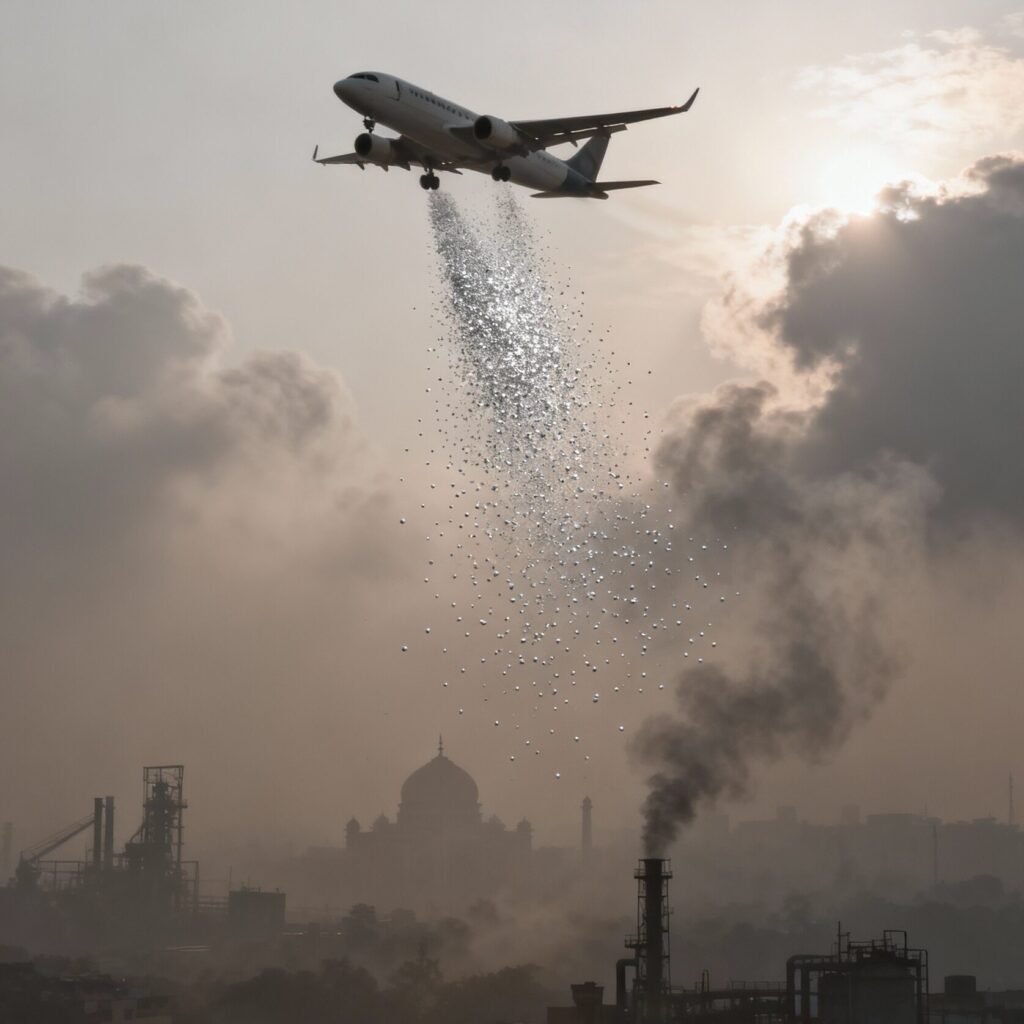
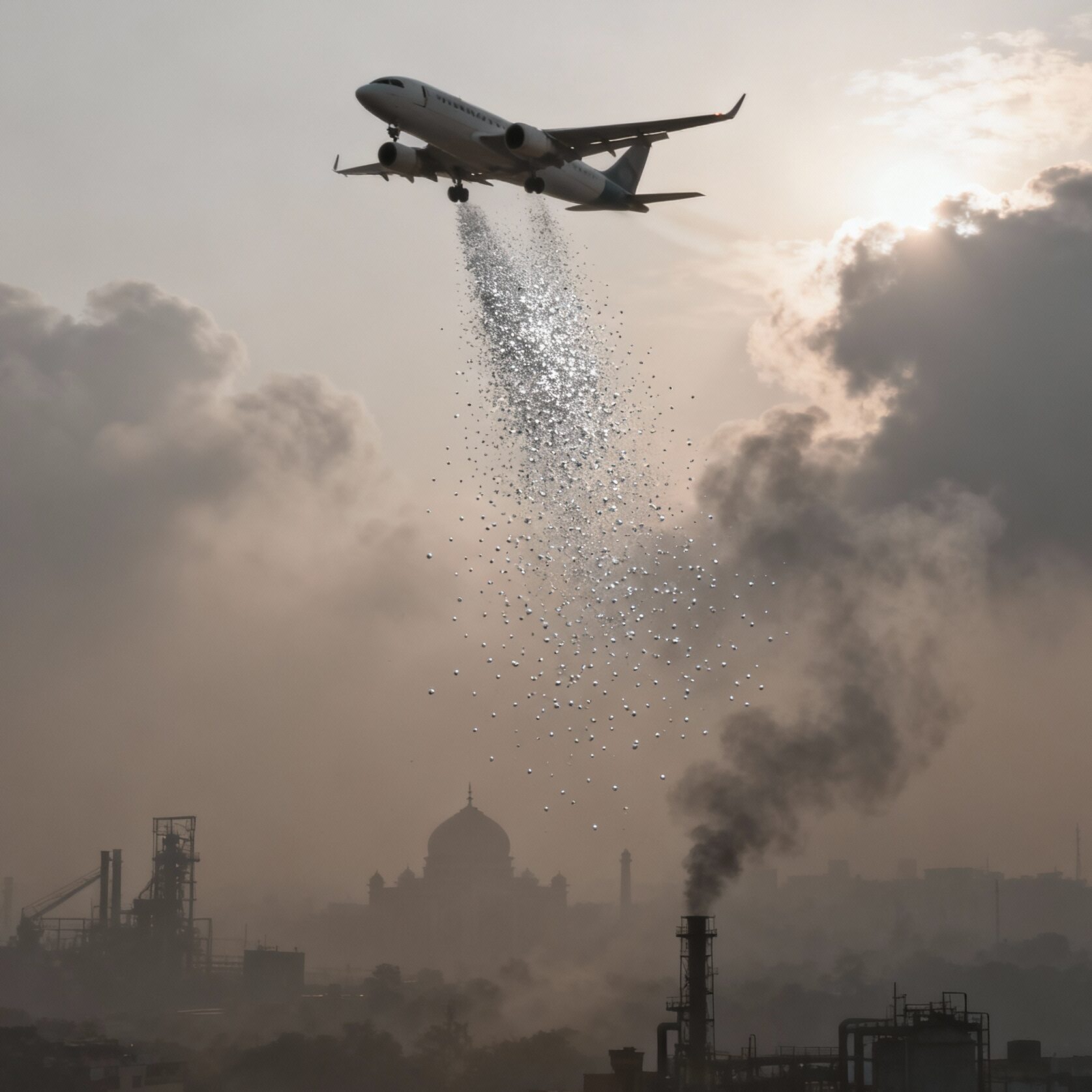
In a groundbreaking environmental intervention, New Delhi launched its first-ever Delhi cloud seeding experiment on October 23, 2025, marking a historic attempt to combat the city’s devastating air pollution crisis through artificial rain. The trial flight, conducted jointly by the Delhi government and IIT Kanpur over Burari in North Delhi, represents an unprecedented scientific approach to washing away the toxic smog that annually chokes India’s capital during winter months.
While the initial test didn’t produce rainfall due to insufficient moisture levels, just 15% humidity compared to the required 50% but officials have declared the technical systems operational and are targeting October 29, 2025, for the city’s first artificial rain if weather conditions cooperate. This bold initiative positions Delhi as the first Indian city to deploy a cloud seeding experiment specifically for pollution control, though scientific effectiveness remains hotly debated.
What is Cloud Seeding and How Does the Delhi Experiment Work?
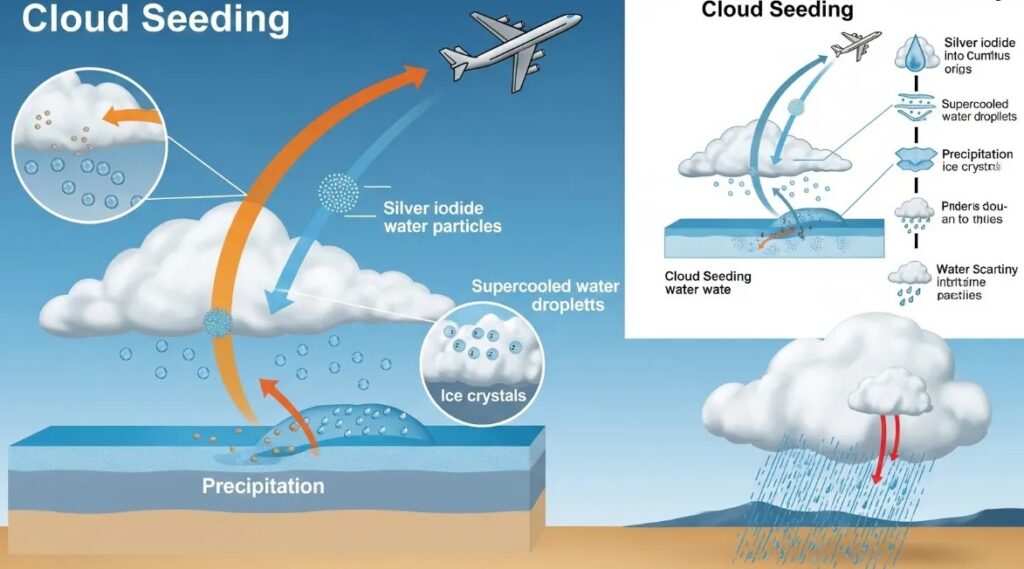
The Delhi cloud seeding experiment employs a well-established meteorological technique that has been used globally for decades, though its application for urban pollution control represents an innovative adaptation.
The Science: Cloud seeding involves dispersing specific particles into moisture-rich clouds to trigger precipitation. A Cessna aircraft equipped with specialized flares releases a mixture of silver iodide, sodium chloride (common salt), and rock salt into clouds. These particles act as condensation nuclei-tiny surfaces around which water droplets can form and eventually combine into raindrops heavy enough to fall.
The Delhi process uses nano-sized silver iodide particles, micro-sized common salt, and rock salt combined with desiccants to prevent lumping. The aircraft’s gas exhaust mechanism injects chemicals into clouds from below.
Critical Requirements: For cloud seeding to work effectively, several conditions must align: adequate cloud cover, at least 50% humidity, appropriate temperature, and favorable wind patterns. The October 23 trial encountered humidity levels of just 15%, explaining why no precipitation occurred despite successful chemical dispersion.
The October 23 Trial Flight: Technical Success, No Rain
The trial flight achieved its primary objectives despite producing no rainfall, demonstrating that technical systems and inter-agency coordination functioned as designed.
Flight Details: The Cessna aircraft departed IIT Kanpur’s airstrip for a four-hour mission testing aircraft readiness, flare deployment systems, and coordination among multiple agencies including the India Meteorological Department (IMD), IITM Pune, and the Directorate General of Civil Aviation (DGCA). The route covered Kanpur-Meerut-Khekra-Burari-Sadakpur-Bhojpur-Aligarh-Kanpur, with cloud-seeding flares fired between Khekra and Burari.
IIT Kanpur Director Manindra Agrawal explained: “We needed to verify that all systems work and that the chemicals disperse properly. While there was insufficient moisture for rainfall, the aircraft and seeding systems performed as expected”.
Political Response: Delhi Chief Minister Rekha Gupta hailed the trial as “historic” and “a significant technological milestone in the capital’s fight against air pollution.” Environment Minister Manjinder Singh Sirsa thanked Prime Minister Narendra Modi for facilitating permissions.
October 29 Target: Weather-Dependent Hope
Following the successful technical trial, Delhi officials have announced October 29, 2025, as the target date for the city’s first artificial rain, contingent on favorable weather conditions.
Weather Window: The India Meteorological Department has forecast cloudy conditions for October 28, 29, and 30, creating a potential window for successful operations. CM Gupta stated: “According to the weather department, cloudy conditions are expected on October 28, 29, and 30. If the weather remains favourable, Delhi is likely to witness its first artificial rain on October 29”.
Five Planned Trials: The Delhi government has approved a ₹3.21 crore project (approximately $385,000) authorizing five cloud-seeding trials specifically targeting northwest Delhi during the post-Diwali smog period. These operations will be conducted under strict safety protocols approved by the DGCA.
Operational Challenges: Flights originate from IIT Kanpur rather than Delhi because “getting permission to take-off and land in Delhi is a challenge. Also, there are far too many take-offs and landings at Delhi airport,” explained IIT Kanpur Director Agrawal.
Delhi’s Pollution Crisis: Why This Desperate Measure?
The Delhi cloud seeding experiment emerges from a desperate annual reality: Delhi’s air quality regularly reaches hazardous levels that pose severe health risks to its 30 million residents, with winter pollution reducing average life expectancy by approximately 12 years.
Post-Diwali Catastrophe: Following Diwali 2025, Delhi recorded its worst PM2.5 levels since January, with air quality plunging into the “severe” category. The Air Quality Index reached hazardous levels as thick smog blanketed the city, driven by firecracker emissions, stubble burning, vehicular exhaust, industrial pollution, construction dust, and stagnant winter air that traps pollutants near ground level.
Pollution Sources: Delhi’s annual air crisis stems from emissions from over 12 million vehicles, industrial activities, construction work, open waste burning, power plants, and seasonal crop stubble burning in neighboring states. Winter temperature inversion, where warmer air traps cooler polluted air near the ground, exacerbates the problem.
Health Impact: The World Health Organization documents that Delhi residents are exposed to PM2.5 concentrations far exceeding safe levels. Fine particulate matter penetrates deep into lungs and bloodstreams, causing respiratory diseases, cardiovascular problems, and reduced cognitive development in children. The Energy Policy Institute at the University of Chicago estimates that pollution reduces Delhi residents’ life expectancy by 12 years compared to WHO-recommended levels.
Does Cloud Seeding Actually Reduce Pollution?
While the Delhi cloud seeding experiment represents a bold initiative, scientific evidence regarding its effectiveness for pollution control remains mixed and contested.
Limited Evidence: Research on cloud seeding’s impact on air pollution is less extensive than studies on rainfall augmentation. A 2014 Beijing study found that a 1mm increase in precipitation intensity led to a 4-28% reduction in PM2.5 levels. However, a 2020 study concluded that this reduction depends heavily on rainfall type, amount, existing pollution levels, and wind speed.
What It Can and Can’t Do: Artificial rain can help clear particulate matter (PM2.5 and PM10) from the atmosphere by physically washing particles to the ground. However, it has no impact on gaseous pollutants like ozone, nitrogen dioxide, sulfur dioxide, and carbon monoxide, major components of Delhi’s pollution.
Temporary Relief Only: Even when successful, cloud seeding provides only short-term relief lasting hours to days. IIT Delhi professors Shahzad Gani and Krishna AchutaRao wrote: “Even when clouds are present, the evidence that seeding reliably increases rainfall remains weak and contested.” They described the Delhi initiative as “a textbook case of science misapplied and ethics ignored”.
Rainfall Enhancement Range: Global studies suggest cloud seeding can increase rainfall by 10-30% under optimal conditions. However, this enhancement depends on pre-existing favorable conditions, adequate cloud cover, sufficient moisture, appropriate temperatures, and conducive wind patterns.
Global Cloud Seeding Programs: Lessons for Delhi
The Delhi cloud seeding experiment joins numerous international programs that have employed this technology for various purposes.
China – World’s Largest Program: China operates the most extensive cloud seeding program globally, using aircraft, rockets, and ground-based generators. The program aims to increase rainfall for agriculture, manage water resources, and clear pollution before major events. China’s 2008 Beijing Olympics famously used cloud seeding to ensure clear skies.
United Arab Emirates – Desert Rain: The UAE has invested heavily in cloud seeding since the 1990s to address water scarcity. Using aircraft and drones, the program conducted 451 flights in 2023 alone, with officials estimating -4 billion cubic meters of enhanced rainfall. The program focuses explicitly on water resources rather than pollution control.
United States – Water Management: Western U.S. states including Utah, Colorado, and California employ cloud seeding primarily to boost snowpack and water supply for reservoirs, supporting agriculture, hydroelectric power, and municipal water needs.
India’s Previous Experiments: Cloud seeding isn’t new to India. Tamil Nadu and Maharashtra experimented with the technology in the 1970s to combat droughts. Karnataka launched the Varuna project in 2017 to increase rainfall in dry regions. However, Delhi is the first Indian city deploying it specifically for pollution control, a fundamentally different application.
Key Difference: Most global cloud seeding programs target water resource management in relatively clean atmospheres. Delhi’s attempt to use it for pollution control in a heavily polluted urban environment with unreliable cloud cover represents uncharted territory with limited precedent.
The Controversy: Scientific Debate and Political Theater
The Delhi cloud seeding experiment has sparked intense debate about whether it represents innovative problem-solving or expensive distraction from root causes.
Scientific Criticism: Leading atmospheric scientists have expressed strong reservations. IIT Delhi’s Gani and Achutharao argue that the effectiveness of cloud seeding “remains weak and contested,” even in ideal conditions, and Delhi’s winter weather rarely provides those conditions. They contend the initiative diverts focus from proven interventions like emission controls, public transportation improvements, and industrial regulation.
The World Meteorological Organization (WMO) notes that definitive proof of cloud seeding effectiveness remains elusive despite decades of research.
Political Opportunism: Critics, including opposition party leaders, have accused the ruling BJP of engaging in “scientific theatrics.” AAP leader and Burari MLA Sanjeev Jha questioned why the “historic” experiment was conducted “secretly” without informing local representatives or residents potentially exposed to chemicals like silver iodide. He raised concerns about health impacts: “The chemicals used in such a process, like silver iodide, could harm eyes, skin and lungs of residents”.
Distraction from Real Solutions: Environmental activists contend that Delhi’s ₹3.21 crore cloud seeding project distracts from proven solutions: strictly enforcing emission standards, expanding metro networks, electrifying public transportation, banning crop burning effectively, upgrading industrial processes, and implementing comprehensive urban planning.
Green Firecracker Contradiction: The Delhi government faced widespread criticism for promoting “green fireworks” for Diwali despite their pollution impact, then turning to expensive technological interventions. Critics argue this represents inconsistent environmental policy prioritizing political optics over scientific coherence.
Complementary Ground Measures: Beyond Artificial Rain
While the Delhi cloud seeding experiment generates headlines, Delhi authorities have simultaneously deployed extensive ground-level interventions.
Enforcement Teams: On the trial day, Delhi deployed over 2,000 enforcement teams across the city to tackle pollution sources directly. These teams monitor construction sites, industrial facilities, waste burning, and vehicular emissions.
Anti-Smog Technology: The city has deployed 376 anti-smog guns and 266 water sprinklers that spray fine water mist to settle airborne particulate matter. While these provide localized temporary relief, their city-wide impact remains limited.
Vehicle Restrictions: Delhi has reintroduced the “odd-even” vehicle restriction scheme where vehicles with odd and even license plate numbers can operate on alternate days, aiming to reduce vehicular emissions.
Air Purifiers in Government Buildings: The Delhi Secretariat has installed 15 air purifiers to protect staff from the city’s toxic air, a measure critics point to as evidence that authorities acknowledge severity while failing to address root causes comprehensively.
Conclusion: Bold Experiment or Expensive Distraction?
The Delhi cloud seeding experiment represents either an innovative breakthrough in urban environmental management or an expensive distraction from addressing pollution’s root causes, the verdict depends largely on whether October 29’s targeted artificial rain materializes and delivers measurable benefits.
Technically, the October 23 trial demonstrated that Delhi possesses the capability to conduct cloud seeding operations when weather permits. The coordination among IIT Kanpur, multiple government agencies, and various stakeholders reflects impressive organizational capacity.
Scientifically, however, the evidence base for cloud seeding’s effectiveness in pollution control remains weak and contested. Even successful rainfall augmentation in ideal conditions produces only temporary pollution relief, washing particulate matter to the ground while leaving gaseous pollutants untouched. Delhi’s winter weather, characterized by low humidity, sparse cloud cover, and stagnant air, rarely provides conditions conducive to successful seeding.
The deeper question is whether pursuing artificial rain represents appropriate resource allocation when proven interventions, strict emission controls, expanded public transit, industrial upgrades, effective crop-burning bans, and comprehensive urban planning, remain inadequately funded and enforced. Critics rightly note that ₹3.21 crore could support substantial permanent improvements rather than five experimental trials of uncertain value.
Yet dismissing the experiment entirely misses potential value. If successful, Delhi’s initiative could establish precedents for other polluted cities, contribute to scientific understanding of cloud seeding applications, and demonstrate governmental willingness to explore all available tools.
The October 29 target date will provide the first real test. If clouds materialize, humidity reaches required levels, and artificial rain falls, Delhi will experience a genuine breakthrough moment. If pollution levels measurably drop and stay suppressed for meaningful duration, it validates the approach. But if weather conditions prove unsuitable or rain falls but pollution quickly returns, it will reinforce critics’ arguments about pursuing scientifically dubious quick fixes rather than sustainable solutions.
Delhi’s residents, meanwhile, continue suffering through toxic air that steals years from their lives. Whether salvation arrives from the skies through silver iodide or from the ground through emission reductions, the urgency remains undeniable. The Delhi cloud seeding experiment may ultimately prove most valuable not for what it achieves directly, but for focusing attention on a crisis that demands comprehensive action, from whatever direction that action comes.