
India’s Game Changing Foreign Policy: From Nehruvian Idealism to Strategic Swagger (1947–2025)
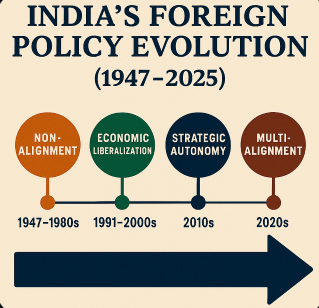
India’s foreign policy journey is a masterclass in diplomatic evolution. From a historically challenged economy rooted in post-colonial idealism, we are now boldly stepping into the 21st century with a clear vision to become the ‘vishwaguru’. From non-alignment to multi-alignment, from moral posturing to muscular pragmatism, India’s global stance has shifted dramatically. And if you’re wondering how we got here, buckle up. This isn’t just history, it’s strategy, drama, and a bit of desi flair.
The Nehruvian Blueprint: Idealism Meets Reality
At independence, India’s first Prime Minister Jawaharlal Nehru envisioned diplomacy rooted in anti-colonialism, non-alignment, and Panchsheel principles (sovereignty, non-aggression, peaceful coexistence). He rejected Cold War binaries and championed the Non-Aligned Movement (NAM) alongside Yugoslavia, Egypt, Indonesia and Ghana, a coalition of newly independent nations refusing to be pawns in the US-Soviet rivalry.
But Nehru’s idealism clashed with realpolitik.
The 1962 Sino-Indian war exposed the limits of moral diplomacy. India’s trust in China was wrecked, and the need for strategic preparedness became bitterly clear.
Nehru’s diplomacy setup was like a startup with a strong mission but no contingency plan. Great pitch, shaky execution.
Cold War Calculations and the Non-Aligned Movement
While NAM was India’s diplomatic badge of honour, it didn’t mean total neutrality. India leaned towards the Soviet Union for defence and economic support, especially after the 1971 Bangladesh Liberation War. The Indo-Soviet Treaty of Peace and Friendship (1971-1991) was a strategic hedge against US-Pakistan-China alignment.
India’s balancing act was non-aligned but not uninvolved; it was a tightrope walk. It gave India room to manoeuvre but also limited its global influence.
WattsPoppin Take: Think of NAM as India’s way of saying “I’m not picking sides, but I do have a favourite cousin.”
The 1991 Economic Pivot: Liberalisation and Global Repositioning
The 1991 balance of payments crisis forced India to liberalise its economy. This wasn’t just a domestic shift, but it was a diplomatic reset. Opening up to global markets meant engaging with Western powers, international institutions, and trade blocs.
India’s foreign policy became more economically driven, focusing on attracting investment, securing energy supplies, and building tech partnerships.
Brand Angle: Liberalisation was India’s “glow-up” moment, which meant a new wardrobe, new friends, and a LinkedIn profile that finally popped.
Nuclear Tests and Strategic Autonomy
With its first nuclear test, “Smiling Buddha” in 1974, India signalled its entry into the nuclear club. In 1998, India conducted nuclear tests in Pokhran, declaring itself a nuclear power. The global backlash was swift with sanctions, criticism, and isolation. But India stood firm, asserting its strategic autonomy.
The tests weren’t just about defence; rather, they were a statement: India would define its security parameters, even if it meant defying global norms.
WattsPoppin POV: India went full “main character energy” here. Risky, bold, and unapologetically sovereign.
Post-2000s: The Rise of Multi-Alignment
The 2000s saw India ditch rigid non-alignment for multi-alignment, building strategic partnerships across the globe. From deepening ties with the US (the civil nuclear deal) to engaging with Israel, to the Look East Policy- ASEAN, Japan, and the rise of BRICS, India embraced a flexible, interest-based diplomacy.
This era was marked by:
- Economic diplomacy: Trade deals, tech collaborations
- Defence partnerships: Joint exercises, arms imports
- Diaspora leverage: Soft power through global Indian communities
Brand Vibe: Multi-alignment is like being with multiple people but being honest about it. Strategic, not shady.
Modi Era: Assertive Diplomacy and Global Branding
Since 2014, PM Narendra Modi has rebranded India’s diplomacy with a mix of assertiveness and outreach. Key pillars include:
Neighborhood First
India prioritised its regional ties with Bangladesh, Sri Lanka, and Nepal through infrastructure, aid, and cultural diplomacy.
Global South Leadership
India positioned itself as a voice for developing nations, especially during its G20 presidency.
Strategic Assertiveness
From surgical strikes to border standoffs with China, India showcased military resolve.
Diaspora Diplomacy
Modi’s global tours weren’t just photo ops, but they were strategic engagements with Indian communities abroad.
WattsPoppin Lens: Modi’s foreign policy is part diplomacy, part influencer tour. Think geo-strategy meets global branding.
India in 2025: A Balancing Act of Power and Principle
As of 2025, India’s geopolitical diplomacy is defined by strategic balancing:
- Navigating US-China tensions without picking sides
- Deepening Quad ties while maintaining BRICS relevance
- Advocating for UN reforms and climate justice
- Leading digital diplomacy and tech governance
India’s challenge is to maintain strategic autonomy while expanding global influence. It’s no longer just reacting, but it’s shaping the narrative.
WattsPoppin Forecast: India’s foreign policy is now a chessboard, not a tug-of-war. Every move is calculated, every silence strategic.
Key Takeaways for Today’s Geopolitical Landscape
- From idealism to pragmatism: India’s journey reflects a shift from moral posturing to interest-based diplomacy.
- Strategic autonomy is non-negotiable: Whether it’s defence, tech, or trade, India insists on self-defined terms.
- Multi-alignment is the new normal: Flexibility is India’s biggest diplomatic asset.
- Soft power matters: Culture, diaspora, and digital influence are key tools.
- Assertiveness is here to stay: India isn’t afraid to flex when needed.
Final Thoughts: Why This Matters for You
Whether you’re a policy nerd, a startup founder, or just someone who loves decoding global drama, India’s foreign policy evolution is a blueprint for strategic growth. It’s about knowing your values, adapting to change, and never losing sight of the big picture.
WattsPoppin Wrap-Up: India’s foreign policy isn’t just about borders and treaties; it’s a story of ambition, resilience, and reinvention. And honestly? It’s kind of iconic.