
In one of the most audacious art thefts in modern history, four masked thieves executed a meticulously planned Louvre museum heist that stunned the world on October 19, 2025. The brazen daylight robbery saw criminals breach the world’s most visited museum, making off with eight priceless Napoleonic jewels valued at €88 million ($102 million) in just seven minutes, spending only four of those minutes inside the Gallery of Apollo.
The shocking speed and precision of the operation has raised serious questions about security at one of the world’s most iconic cultural institutions, while also inspiring an unexpected viral marketing response. Indian adhesive brand Fevicol seized the moment with a clever campaign that turned the Louvre museum heist into a witty advertisement, demonstrating how brands can capitalize on global events with timely, creative marketing.
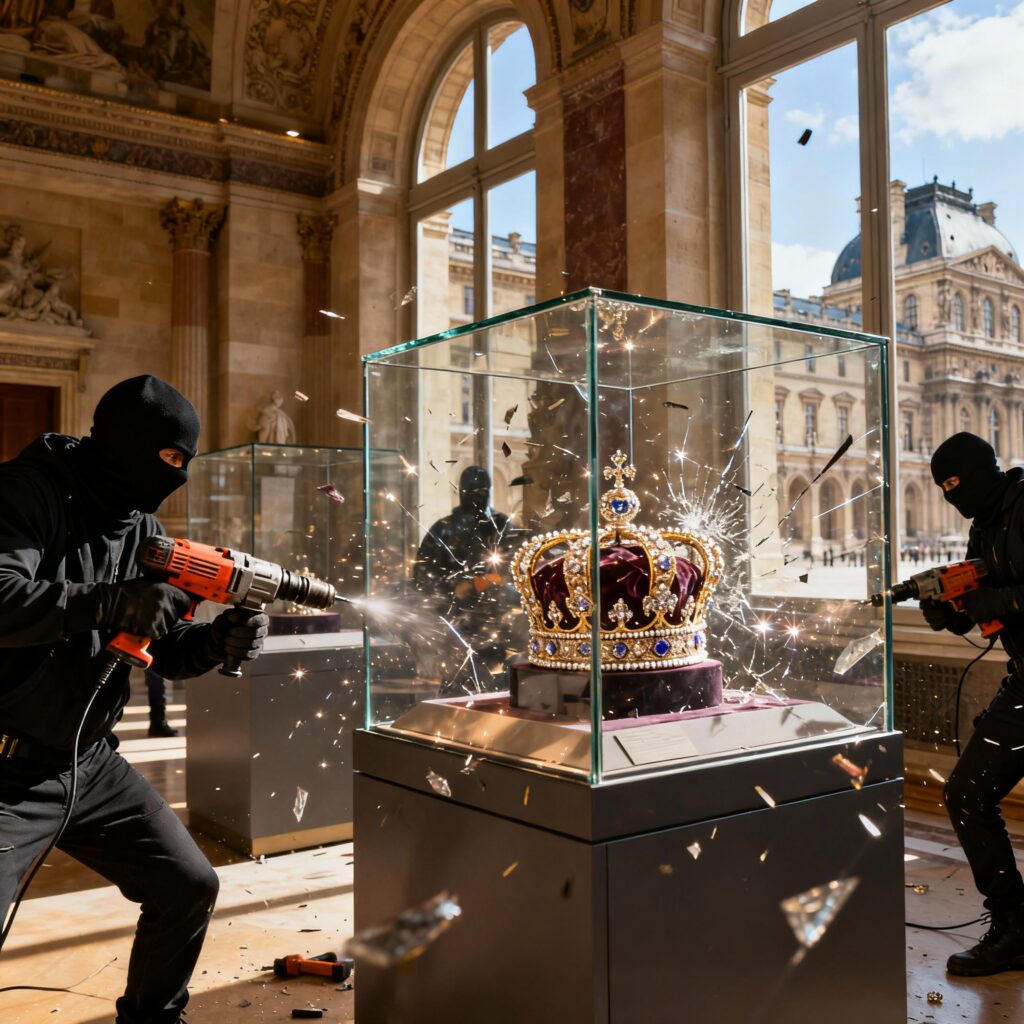
The 7-Minute Heist: Minute-by-Minute Breakdown
The Louvre museum heist unfolded with military precision during peak visiting hours, exploiting critical security vulnerabilities.
9:30 AM – Arrival: A stolen truck equipped with an extendable crane basket arrived at the Louvre’s Seine-facing side. The thieves, disguised as construction workers in bright yellow high-visibility jackets, raised the mechanical ladder toward a second-floor balcony overlooking the Gallery of Apollo. The museum had opened just 30 minutes earlier.
9:34 AM – The Break-In: Two thieves scaled the ladder and used an angle grinder to cut through a window providing direct access to the Apollo Gallery, located approximately 250 meters from where the Mona Lisa hangs. This entry point was a critical vulnerability, museum director Laurence des Cars later admitted no security cameras covered this specific balcony.
9:34-9:38 AM – Four Minutes of Theft: Once inside, the thieves worked with extraordinary speed. Using power tools including angle grinders and a blowtorch, they smashed two reinforced display cases specifically designed to withstand bullets. Within four minutes, they extracted eight pieces of jewelry from the French Crown Jewels collection.
Curiously, they ignored the Regent Diamond, housed in the same gallery and valued at over €60 million. French magistrate Laure Beccuau stated, “I don’t have an explanation. Only when they are in custody will we know what orders they had”.
9:38 AM – The Escape: The thieves descended and joined their accomplices. In their haste, they dropped Empress Eugénie’s ornate gold crown set with 1,300 diamonds, which was recovered damaged outside. They attempted to set fire to their truck to destroy evidence, but a museum employee extinguished the flames.
9:39 AM – Clean Getaway: The four thieves fled on two motorcycles, disappearing into Paris traffic before security forces could respond. One scooter and a helmet were later recovered for DNA analysis.
The Stolen Treasures: Napoleon’s Priceless Legacy
The Louvre museum heist targeted pieces with “inestimable heritage and historical value” representing irreplaceable fragments of French imperial history.
Empress Marie-Louise’s Emerald Set: The most significant piece stolen was an emerald necklace containing more than 1,000 diamonds, gifted by Napoleon Bonaparte to his second wife in 1810 as a wedding present. The matching emerald earrings completed a set representing one of the finest examples of Napoleonic jewelry craftsmanship.
Royal Crowns: Two spectacular crowns were stolen. The first, given by Emperor Napoleon III to Empress Eugénie in 1853, contains more than 200 pearls and nearly 2,000 diamonds. The second is a sapphire-and-diamond diadem worn by Queen Marie-Amélie and Queen Hortense, with a matching necklace and single earring.
Additional Treasures: The thieves also took a diamond-encrusted reliquary brooch and a large diamond bodice bow worn by Empress Eugénie.
Auction house president Alexandre Giquello estimated the recovered crown’s value at “several tens of millions” of euros, noting “it’s not, in my opinion, the most important item” among the stolen pieces, underscoring the extraordinary value of what remains missing.
Catastrophic Security Failures
The Louvre museum heist exposed shocking security failures at an institution welcoming over 9 million visitors annually.
No Camera Coverage: The most shocking revelation was that no security cameras monitored the second-floor balcony where thieves gained entry. This fundamental surveillance gap at one of the world’s most scrutinized buildings stunned investigators.
Director des Cars explained that the Apollo Gallery’s internal security “functioned flawlessly,” but was designed years ago for different threats. The display cases were bullet-resistant, but not designed to withstand sustained assault with industrial power tools.
Chronic Understaffing: Museum staff unions had warned for months about “too few eyes on too many rooms.” Internal audits allegedly revealed hundreds of security positions had been cut, leaving critical areas inadequately monitored.
Broken Alarm System: French Senator Sylvie Robert revealed that a local alarm system in the Apollo Gallery had been broken for weeks. When thieves smashed the display cases, the specific alert that should have brought immediate response was inoperative.
Government Response: French Interior Minister Gérald Darmanin bluntly stated, “We have failed,” while President Macron denounced the theft as “an attack on a heritage that we cherish.” The incident has been compared to the 2019 Notre-Dame fire as a cultural wound to France.
Race Against Time: Why Experts Fear the Jewels Are Lost Forever
Art recovery specialists warn the Louvre museum heist triggered a race against time, with treasures potentially already destroyed.
24-48 Hour Window: Chris Marinello, chief executive of Art Recovery International, told BBC that investigators had between 24 and 48 hours to retrieve the jewels intact. “They are not going to keep them intact, they are going to break them up, melt down the valuable metal, recut the valuable stones and hide evidence of their crime”.
This timeline has passed, leading experts to fear the worst. Unlike paintings, jewelry can be dismantled, with gemstones recut and precious metals melted, effectively destroying historical artifacts to create untraceable commodities.
Art recovery expert Arthur Brand described the theft as a “national disaster,” noting that because the pieces are so recognizable, thieves will likely dismantle them. “These are the crown jewels from Napoleon, his wife and his successors. So these are the natural pride of France. It’s a great loss”.
French police believe the heist was orchestrated by an organized crime network with sophisticated knowledge of museum security and black market networks. Sixty investigators are analyzing CCTV footage, DNA evidence, and tracking potential exits from France.
Fevicol’s Marketing Masterstroke: Turning Tragedy into Viral Gold
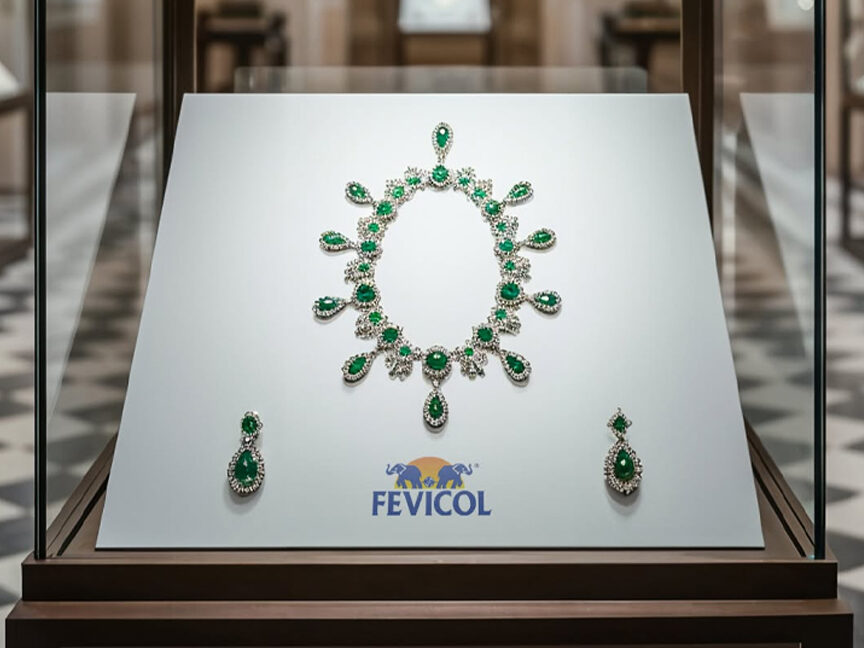
While France mourned the Louvre museum heist, Indian adhesive brand Fevicol saw an opportunity for creative marketing that demonstrated the power of real-time marketing in the social media age.
The Viral Ad: On October 22, 2025, just three days after the heist, Fevicol released an image on Instagram showing Empress Marie-Louise’s emerald necklace and matching earrings displayed on a platform bearing the Fevicol logo. The clever tagline read: “Ab Dhoom machane ki baari hamari (Time to steal the show). This mission is impossible”.
The ad brilliantly combined multiple pop culture references. “Ab Dhoom machane ki baari hamari” referenced the hit Bollywood heist film Dhoom 2, while “This mission is impossible” nodded to the Hollywood Mission: Impossible franchise. The underlying message was unmistakable: had the Louvre used Fevicol, the theft would have been impossible.
Explosive Social Media Success: The advertisement exploded online, amassing over 35,000 likes within hours and generating widespread media coverage. It became Fevicol’s most successful recent social media campaign, demonstrating how timely, culturally relevant humor can amplify brand messaging.
Social media users praised the creativity extensively: “Your team needs a raise for this idea,” “The most creative advertisement ever,” “Fevicol needs to calm down,” “Ate and left no crumbs,” and “Genius.” Bluestone Jewellery commented, “Fevicol understood commitment goals better than half of Instagram”.
Brand Response Trend: Fevicol wasn’t alone in capitalizing on the heist. German lift manufacturer Bocker, whose crane equipment was used in the robbery, also released a campaign with the tagline “When You Need To Move Fast”, turning its involuntary association with international crime into marketing gold.
Creative Advertising Legacy: Fevicol has built its reputation on clever, culturally resonant advertising that blends humor with its core message: “Yeh Fevicol ka mazboot jod hai, tootega nahi” (This is Fevicol’s strong bond, it won’t break). The brand consistently transforms current events into memorable campaigns that reinforce brand positioning.
The Louvre museum heist campaign represents Fevicol’s creative advertising at its peak, taking a tragic international incident and finding a way to communicate brand values without appearing callous. The humor worked because it was clever rather than mocking, suggesting prevention rather than celebrating the crime.
Museum Response and Aftermath
Three days after the Louvre museum heist, the museum reopened to long lines of tourists, though the Apollo Gallery remained sealed.
Enhanced Security Measures: Director des Cars proposed several enhancements: reinforcing the museum’s perimeter, banning nearby vehicle parking, installing additional CCTV coverage, and establishing a dedicated police station within the museum. These proposals represent the most significant security overhaul in the Louvre’s recent history.
Jewel Transfer to Bank of France: In a dramatic security response, the Louvre transferred its most precious remaining jewels to the Bank of France on October 25. The transfer, conducted under heavy police escort, moved valuable items to the bank’s vault located 27 meters below ground, where France’s gold reserves are stored. This unprecedented measure demonstrates how seriously authorities are taking the security vulnerabilities exposed.
Historical Context: The Louvre museum heist joins a notorious history including the 1911 Mona Lisa theft by museum employee Vincenzo Peruggia, who hid in a cupboard overnight. While previous thefts targeted individual artworks, the 2025 heist stands out for targeting multiple high-value items with extraordinary precision in an impossibly brief timeframe.
Cultural Impact: Memes, Movies, and Public Fascination
The Louvre museum heist has transcended news coverage to become a cultural phenomenon, inspiring countless memes, social media content, and speculation about potential film adaptations.
TikTok, Instagram, and Twitter exploded with content showing “outfits for a jewelry heist,” casting suggestions for movie adaptations, and speculation about a “dapper investigator.” The heist’s cinematic qualities, the precision timing, daring daylight execution, priceless treasures, made it irresistible content for the internet age.
Within France, the heist provoked intense debate about national pride and cultural heritage protection. Opposition leaders labeled the incident a “national humiliation,” while critics point to security failures as evidence of broader institutional decline.
Conclusion: A Watershed Moment
The Louvre museum heist represents far more than a spectacular robbery, it’s a watershed moment that has forced fundamental reassessment of how the world’s great museums protect irreplaceable cultural treasures.
The shocking speed of the operation, the exploitation of known security vulnerabilities, and the likely permanent loss of priceless historical artifacts have created ripples extending far beyond Paris. Museums worldwide are reviewing security protocols and considering whether traditional approaches remain adequate.
For France, the heist represents a cultural wound comparable to the Notre-Dame fire, a loss of national heritage that no amount of money can fully repair. Even if thieves are caught, experts believe the jewelry has likely been destroyed, with gemstones recut and metals melted. The emerald necklace Napoleon gave his wife, the crowns worn by French empresses, these tangible connections to history are probably gone forever.
The Fevicol marketing response, while clever and successful, highlights how quickly tragedy can be transformed into content. The brand’s ability to turn devastating cultural loss into viral advertising demonstrates both marketing sophistication and the strange ways social media has changed how we process world events.
As investigators continue their manhunt and the Louvre implements enhanced security, the Louvre museum heist will be remembered as the day one of the world’s most secure museums proved shockingly vulnerable. The four minutes thieves spent inside the Gallery of Apollo changed not just one museum, but forced the entire cultural preservation world to reckon with new threats they hadn’t adequately prepared to face.
The ultimate irony may be that while Fevicol joked about making theft impossible, the real lesson is darker: no security is perfect, and determined criminals with planning can breach even the world’s most famous fortresses. The question now is whether museums can adapt security faster than criminals can adapt their methods, before the next daring heist writes another tragic chapter in the story of lost cultural heritage.