
The 80th session of the UN General Assembly 2025 opened on September 23, 2025, marking a historic milestone in international diplomacy as world leaders gathered in New York to address an increasingly complex global landscape. Under the theme “Better Together: 80 years and more for peace, development and human rights,” over 150 heads of state and government delivered powerful speeches that highlighted both the achievements of multilateral cooperation and the urgent challenges facing humanity.
Opening Ceremony and Key Themes
Secretary-General António Guterres set the tone for the assembly by acknowledging that the UN’s foundational principles are “under siege as never before”. Speaking during the 80th anniversary celebration, Guterres painted a sobering picture: “As we gather, civilians are being targeted, and international law is being disregarded in Gaza, Ukraine, Sudan, and beyond. Poverty and hunger are escalating, the planet is ablaze, with fires, floods, and unprecedented heat resulting from climate turmoil”.
UN General Assembly President Annalena Baerbock of Germany emphasised the critical juncture facing the international community: “We cannot choose the easier route and simply surrender. We must select the correct path, demonstrating to the world that we can improve together, not because the past 80 years have been flawless, but because we have endeavoured for 80 years”.
Brazil’s Lula Opens with Climate Justice and Democracy Defence
Brazilian President Luiz Inácio Lula da Silva, following the traditional protocol as the first speaker, delivered a forceful address focused on climate action, democratic values, and Global South empowerment. Declaring that “COP30 will be the COP of truth,” Lula announced Brazil’s commitment to reduce emissions by 59-67% across all sectors, while launching the Tropical Forests Forever Fund to reward countries that preserve their forests.
Lula condemned what he termed the “ongoing genocide in Gaza,” stating that “nothing, absolutely nothing, justifies” the disproportionate use of force in Palestine. He also defended Brazilian sovereignty against what he characterised as US interference, declaring that “our democracy is non-negotiable” and criticising “unilateral and arbitrary measures” against Brazilian institutions.
The Brazilian leader advocated for UN Security Council reform and emphasised the growing importance of multilateral bodies like BRICS, G20, CELAC, ASEAN, and the African Union in representing the voice of the Global South.
Trump’s Controversial Return to the UN Podium
US President Donald Trump’s address marked his return to the UN General Assembly after five years, delivering a characteristically controversial speech that challenged many UN principles. Trump exceeded the traditional 15-minute speaking limit while making several provocative statements that drew international attention.
On climate change, Trump dismissed global warming as “the greatest con job ever” and accused other countries of breaking pollution rules. “The carbon footprint is a hoax, made up by people with evil intentions,” he declared, directly contradicting the scientific consensus and the UN’s climate agenda.
Trump also made inflammatory comments about immigration, stating that European countries are “going to hell” because of migration and calling for an end to “the failed experiment of open borders”. He controversially alleged that China and India are the “primary funders” of Russia’s Ukraine war, a claim that lacks substantiated evidence.
Despite his criticism of multilateralism, Trump called for a ceasefire in Gaza while blaming Hamas for rejecting peace offers, and stated that recognising a Palestinian state “would be too great for Hamas”.
Ukraine’s Zelenskyy Warns of Global Arms Race
Ukrainian President Volodymyr Zelenskyy delivered one of the most urgent addresses of the assembly, warning that the world is experiencing “the most destructive arms race in human history”. Appearing in his characteristic military-style attire, Zelenskyy argued that international institutions have become “too weak” to prevent wars.
“No one but ourselves can guarantee security,” Zelenskyy declared. “Only strong alliances. Only strong partners. And only our own weapons”. He emphasised that “weapons decide who survives,” calling this reality “terrible” but unavoidable.
The Ukrainian leader pointed to Russian drone incursions into Poland and fighter jet violations of Estonian airspace as evidence that even NATO membership doesn’t guarantee protection from Russian aggression. He also expressed concern about Moldova’s stability and warned that “Europe cannot afford to lose Moldova”.
Zelenskyy stressed the need for continued international support for Ukraine, arguing that Putin intends to expand the conflict beyond Ukraine’s borders: “Ukraine is merely the initial target, and already Russian drones are traversing Europe, with Russian military activities extending into other nations”.
Netanyahu Faces Diplomatic Isolation
Israeli Prime Minister Benjamin Netanyahu’s speech was marked by widespread diplomatic protests as dozens of officials and diplomats walked out of the General Assembly hall, leaving large sections empty. Outside, demonstrators opposed to Israel’s military actions in Gaza gathered in Times Square.
Netanyahu defended Israel’s military operations over the past year, claiming that Israel had achieved “one of the most stunning military comebacks in history” after the October 7, 2023, Hamas attacks. He outlined Israeli successes against what he called Iran’s “terror axis,” stating: “We’ve hammered the Houthis, including yesterday. We crushed the bulk of Hamas’s terror machine. We crippled Hezbollah, taking out most of its leaders and much of its weapons arsenal”.
The Israeli Prime Minister vehemently opposed the recent recognition of Palestinian statehood by several Western nations, calling it a “mark of shame” that rewards “the most savage terrorists on earth”. He insisted that Israel “will not allow you to shove a terrorist state down our throats,” claiming this position represents “the policy of the State and people of the State of Israel”.
Netanyahu dismissed UN commission findings of genocide in Gaza as “baseless” and addressed hostages directly: “We have not forgotten you, not even for a second, we will not rest until we bring all of you home”.
India’s Jaishankar Critiques UN Effectiveness
India’s External Affairs Minister S. Jaishankar delivered a scathing assessment of the UN’s current state, declaring that “the UN is in a state of crisis” and describing the organisation as “gridlocked” due to resistance to reform.
Jaishankar pointed to ongoing conflicts in Ukraine, the Middle East, and “innumerable hotspots” that “don’t even make the news” as evidence of the UN’s failures. He criticised the slow progress of Sustainable Development Goals as presenting “a sorry picture” and condemned what he called “recirculated commitments and creative accounting” in climate action.
In a direct reference to Pakistan, Jaishankar stated that India has “a neighbour that is an epicentre of global terrorism,” noting that “for decades now, major international terrorist attacks are traced back to that one country”. He called for deeper international cooperation against terrorism and “relentless pressure” on the entire terrorism ecosystem.
Jaishankar advocated for immediate UN Security Council reform, asserting that “both permanent and non-permanent membership of the Council must be expanded” and declaring that “India stands ready to assume greater responsibilities”.
China’s Li Qiang Champions Multilateralism
Chinese Premier Li Qiang positioned China as a defender of international order and multilateralism in contrast to what he characterised as rising unilateralism and protectionism. In his debut appearance at the UN General Assembly as Premier, Li emphasised that “solidarity lifts everyone, while division drags all down”.
Li warned against the return of “unilateralism and a Cold War mindset,” stating that “when might dictates right, the world risks division and regression”. Without explicitly naming the United States, he criticised “tariff hikes and erection of walls and barriers” that worsen global economic sluggishness.
The Chinese leader highlighted China’s contributions to global development, noting that China has contributed about 30% of global economic growth in recent years and remains the world’s second-largest importer. He announced several initiatives, including presenting lunar soil samples from China’s far side moon mission to the UN and establishing a China-UN Global South-South Development Facility with $10 million in initial funding.
Li also called for international cooperation on artificial intelligence governance, urging the establishment of a “world AI cooperation organisation” to ensure “technology for good and equitable benefits”.
France’s Macron Recognises Palestinian State
French President Emmanuel Macron made headlines by officially announcing France’s recognition of the State of Palestine during a high-level conference on the two-state solution. “This is why I declare today that France recognises the state of Palestine,” Macron stated to thunderous applause in the General Assembly hall.
Macron argued that “breaking the cycle [of violence] lies in the recognition of the other” and insisted that recognition advances the cause of peace between Israelis and Palestinians. He acknowledged Hamas’s October 7 attack as an “open wound for Israelis” while maintaining that “nothing justifies the ongoing war in Gaza”.
The French President called for the immediate release of hostages and an immediate ceasefire, warning of potential Israeli expulsion of Palestinians to Egypt and annexation of the West Bank. He expressed concern that the Abraham Accords and Camp David Accords could collapse due to Israeli actions.
France joined the UK, Canada, Australia, Belgium, Portugal, Luxembourg, Malta, Monaco, San Marino, Andorra, and Denmark in recognising Palestinian statehood during the assembly week, bringing the total number of UN member states recognising Palestine to approximately 149.
Key Summit Outcomes and Initiatives
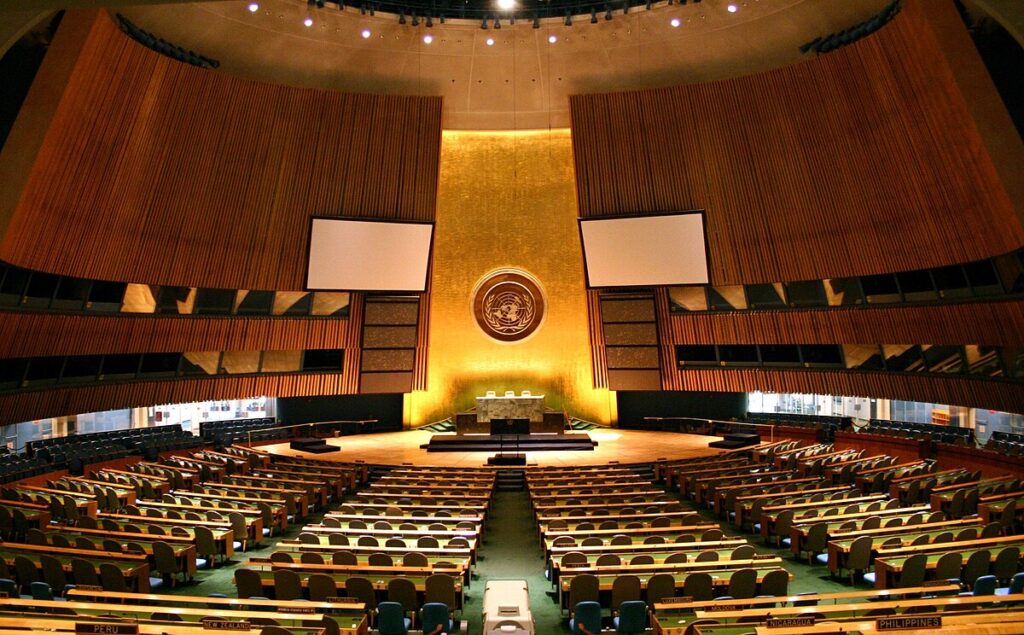
Climate Summit and COP30 Preparation
The UN Climate Summit held on September 24 focused on accelerating action toward the Paris Agreement’s 1.5°C target ahead of COP30 in Brazil. World leaders presented new national climate action plans, with Brazil’s commitment to 59-67% emission reductions serving as a benchmark for other nations.
Non-Communicable Diseases Declaration
The Fourth High-level Meeting on NCDs and Mental Health resulted in strong support for the political declaration “Equity and Integration: Transforming Lives and Livelihoods through leadership and action on noncommunicable diseases and the promotion of mental health and well-being”. The declaration sets ambitious targets for 2030, including 150 million fewer tobacco users and 150 million more people with access to mental health care.
AI Governance Initiative
The High-level Meeting to Launch the Global Dialogue on AI Governance brought together member states and stakeholders to explore frameworks for inclusive and accountable AI governance. China’s announcement of lunar soil sample sharing and AI cooperation proposals highlighted the growing importance of technology governance in international relations.
Palestinian Recognition Wave
The week saw unprecedented momentum for Palestinian recognition, with multiple European nations formally recognising the State of Palestine despite strong opposition from Israel and the United States. This diplomatic shift represents a significant change in international consensus on the Israeli-Palestinian conflict.
Regional Perspectives and Global South Voice
The assembly highlighted the growing influence of Global South perspectives on international affairs. Brazilian President Lula’s emphasis that “the voice of the Global South must be heard” resonated throughout various speeches, with leaders from Africa, Asia, and Latin America calling for more equitable representation in international institutions.
Chinese Premier Li Qiang’s focus on South-South cooperation and his announcement of development initiatives specifically targeting developing nations reflected Beijing’s strategy to position itself as a leader of the Global South. Similarly, India’s critique of wealthy nations’ climate inaction while resource-stressed countries “scramble to survive” emphasised the development divide.
Institutional Reform Calls
Multiple leaders called for comprehensive UN reform, particularly of the Security Council. India’s demand for expanded permanent and non-permanent membership, Brazil’s advocacy for developing country representation[82], and China’s support for making the UN “more efficient and representative” highlighted widespread frustration with current institutional structures.
The calls for reform came amid criticism of the UN’s effectiveness in addressing current global challenges. Ukraine’s Zelenskyy’s assertion that international law doesn’t work without “powerful friends” and military backup reflected growing scepticism about multilateral institutions’ ability to maintain peace and security.
Looking Forward: Challenges and Opportunities
The 80th UN General Assembly concluded with mixed signals about the future of international cooperation. While the theme “Better Together” emphasised unity, speeches revealed deep divisions on key issues, including climate action, regional conflicts, trade policies, and institutional reform.
The assembly demonstrated both the enduring relevance of the United Nations as a forum for global dialogue and the limitations of multilateral diplomacy in addressing 21st-century challenges. As Secretary-General Guterres noted, the UN stands at a crossroads where the choice between cooperation and fragmentation will determine the organisation’s effectiveness in its ninth decade.
The strong support for Palestinian recognition, diverse approaches to climate action, and competing visions of global governance suggest that the international community remains divided on fundamental questions of peace, development, and human rights that the UN was founded to address.